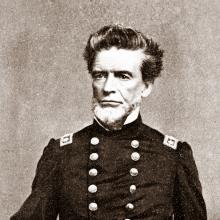
Thomas Overton Moore was an American Thomas cotton and sugar planter and politician. He served as the 16th Governor of Louisiana during the American Civil War.
Background
Thomas Moore was born on April 10, 1804, in Sampson County, North Carolina, United States. He was the son of James Moore, II and Emma Jane Overton, and the descendant of James Moore, who emigrated from Ireland in the seventeenth century to what is now South Carolina and became the governor of the Carolinas in 1700. On his mother's side he was descended from William Overton who emigrated from England to Virginia about 1670.
Education
Thomas received his education in Sampson County and remained there until 1829 when he moved to Rapides Parish, Louisiana, where his uncle, Walter H. Overton, lived.
Career
For some years Thomas Overton Moore managed his uncle's sugar plantation. Later he acquired a plantation of his own in the same parish and soon became one of the important sugar planters of the state.
He was active in local politics rather early and for a number of years served as a member of the police jury of his parish.
In 1848 he was elected to the state House of Representatives and in 1856 to the Senate. He became the candidate of the regular faction of the Democratic party for governor in 1859. Although he was opposed by Thomas J. Wells of the same parish he was elected in the following November and inaugurated in January 1860. After the deadlock in the National Democratic Convention at Charleston he supported the Breckinridge-Lane faction and did much towards the success of that ticket in Louisiana in November. With the election of Lincoln as president he issued a call, on December 10, to determine what course Louisiana should pursue. In his message, he said: "I do not think it comports with the honor and respect of Louisiana, as a slaveholding state, to live under the government of a Black Republican President," and on his recommendation, the legislature called a state convention to meet on January 23, 1861, in order to decide the matter.
Anticipating what the convention would do, he ordered the state troops to take Forts Jackson and St. Philip, which commanded the Mississippi River below New Orleans, and also Fort Pike on the Rigolets and the barracks and arsenal at Baton Rouge, the state capital.
Following the adoption of an ordinance of secession by the state convention, he took the lead in making Louisiana a member of the Confederacy, organizing local companies for defense, establishing supply depots on the Red River, and building packing plants to feed the men under arms. He co-operated with the Confederate government in the prosecution of the war.
In April 1861 he issued a call for 5, 000 troops for the Confederate service in addition to the 3, 000 already asked for by President Davis, and he continued to exert his authority to raise troops and supplies for the armies in the field. He had in the meantime requested the banks to suspend specie payments and had instructed them to accept and payout Confederate treasury notes at par.
His administration was disrupted in June 1862 when, after the capture of New Orleans by Benjamin F. Butler, the Federal government appointed George F. Shepley as military governor of Louisiana. Shepley's administration was effective, however, only in the southern part of the state, and Moore continued to act as governor over central and northern Louisiana, still within Confederate lines, until the end of his term early in 1864.
He moved the capital from Baton Rouge to Opelousas and later to Shreveport. On reaching Opelousas he issued an address to the people of the state directing what to do under the circumstances. Among other things he forbade their trading with the enemy, entering the Federal lines, bearing Federal passports, or accepting Federal money, and he ordered that steamboats be burned rather than allowed to fall into the hands of the enemy. He was greatly handicapped, however, by the loss of New Orleans and the lower river parishes and was therefore unable to carry on an effective administration or to render any great amount of assistance to the Confederate government.
When Banks made a raid up the Red River in the spring of 1864, his plantation in Rapides Parish was confiscated and his home and sugar mill destroyed.
After the surrender of E. Kirby-Smith in May 1865, Moore, whose arrest had been ordered by the Louisiana state Senate newly organized under the constitution of 1864, fled to Havana, Cuba. Through the intercession of friends he was finally allowed to return home with a full pardon, and he spent the remainder of his days trying to restore his plantation and recover the losses he had sustained in the war. He took no further part in party politics.
Achievements
Thomas Overton Moore was a noted politician, who was the 16th Governor of Louisiana from 1860 until 1864 during the American Civil War. After Lincoln's election, Moore directed the state militia to seize control of all Federal military posts in Louisiana. He supported secession and was devoted to the Confederate States of America.
Moore was a Democrat. He was an ardent secessionist. As a governor of the state he not only called the secession convention but in 1861, he called for five thousand Louisiana troops for the Confederacy in addition to the three thousand already requested by President Davis. He cooperated with the Confederate government.
Moore later sponsored a stay law that suspended forced sales of agricultural goods to the Confederate Army.
Connections
On November 30, 1830, Thomas Moore married Bethiah Jane Leonard of Rapides Parish, the daughter of Edward Augustus Leonard and Sarah Morris. The couple's first two children died in infancy, the third lived to be seven, and the fourth to be five; the fifth, Emma Jane, survived and left descendants.