Background
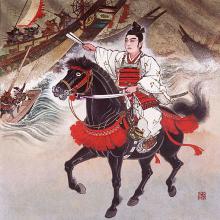
Tokimune Hōjō was born on 5 June 1251 in Japan. He was the eldest son of Hojo Tokiyori.

北条 時宗
Tokimune Hōjō was born on 5 June 1251 in Japan. He was the eldest son of Hojo Tokiyori.
In 1268 he became the eighth shikken, or regent, of the Kamakura shogunate. Around this time envoys began to come to Japan from the Mongol, or Yuan, dynasty of China demanding that Japan acknowledge itself a tributary state of Yuan.
Yuan at this time was under the rulership of Kublai Khan, the fifth of the Mongol emperors and grandson of Genghis Khan, the founder of the dynasty. Later, in 1271, he adopted Yuan as the official name of his dynasty, and in 1279 conquered the Southern Sung and united all of China under his rule.
In 1259 Kublai, as part of his campaign to subjugate all of Asia, had forced the Korean state of Koryo to become a tributary, and now he prepared to use it as a base for an attack on Japan should the Japanese refuse to acknowledge his authority. When the Mongol envoys came with their demands, Tokimune refused to heed them, instead beginning preparations to defend the country against attack.
In 1274 a force of over thirty thousand Mongol and Korean soldiers crossed over from the mainland in a fleet of some nine hundred ships and invaded Hakata in northern Kyushu. The Japanese defenders were easily thrown back, but a violent storm arose in the Japan Sea, inflicting heavy damage on the invaders’ ships and obliging them to withdraw. From the era name of the time, this is called the Bun’ei campaign. In 1275 Kublai sent another envoy de¬manding the submission of the Japanese. This time Tokimune executed the envoy and began construction of a stone battlement along the coast of northern Kyushu to fend off" any future Mongol attack.
In 1281 the Mongol forces appeared again to attack Kyushu, but once more they met with a violent storm that forced them to withdraw. This second attack is known as the Koan campaign, again from the era name of the time. Collectively, the two Mongol assaults are referred to as the “campaign of the Yuan pirates.”
Hojo Tokimune laid plans to launch a counteroffensive against the Mongols and spent large sums of money on military preparations, moves that put a heavy strain on the finances of the shogunate and were one of the causes of its eventual downfall.