

Background
Baer, Werner was born on December 14, 1931 in Offenbach, Germany. Son of Richard and Grete (Herz) Baer. came to the United States, 1945, naturalized, 1952.
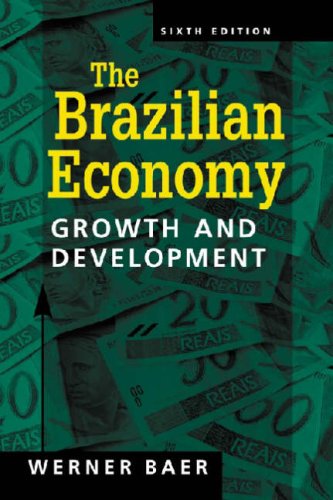
(In this thorough description and analysis of Latin Americ...)
In this thorough description and analysis of Latin America's largest economy, Werner Baer traces the trajectory of Brazil's economic development from the colonial period through the current Lula administration. The sixth edition includes vast amounts of new statistical and institutional information, as well as a detailed assessment of the country's economic performance over the last decade. Current, and often contentious, issues such as privatization, income and regional inequalities, and the environmental impact of development are also extensively explored. Designed to be broadly accessible, this new edition will be valuable in a wide range of venues, from universities to the corporate world to the libraries of development organizations. This book gives a thorough description and analysis of Latin America's largest economy, tracing its trajectory from the colonial period through the current Lula administration.
http://www.amazon.com/gp/product/1588264750/?tag=2022091-20
http://www.amazon.com/gp/product/B013PT1CGI/?tag=2022091-20
Baer, Werner was born on December 14, 1931 in Offenbach, Germany. Son of Richard and Grete (Herz) Baer. came to the United States, 1945, naturalized, 1952.
58776, City University of New York, New York City, 1953. Master of Arts, Harvard University, 1955. Doctor of Philosophy, Harvard University, 1958.
Doctor honoris causa, Federal University Pernambuco, Brazil, 1988. Doctor honoris causa, New University Lisbon, Portugal, 2000. Doctor honoris causa (honorary), Federal University Ceara, Brazil, 1993.
Instructor, Harvard University, 1958-1961. Assistant Professor, Yale University,
1961-1965. Association Professor, Professor, Vanderbilt University, 1965-1969, 1969-1974.
Visiting Professor, University Sao Paulo, Brazil, 1966-1968, Vargas Foundation, Rio de Janeiro,
1966-1968.
Visiting Scholar, Brazilian Planning Ministry, 1975, Brazilian Census Bureau, 1978. Professor of Economics, University Illinois Urbana-Champaign, Urbana, Illinois, United States of America, since 1974.
Editorial Board, World Development, Cambridge Latin American Studies (Cambridge University Press, Cambridge, United Kingdom, 1977-1982), Luso-Brasilian Review, Revista Paraguaya de Estudios Sociologicos, Revista Latinoamericana de Historia Economica y Social.
(In this thorough description and analysis of Latin Americ...)
( Bringing the analysis of Brazil's economic performance ...)
(In this thorough description and analysis of Latin Americ...)
( Written by a distinguished group of noted Latin America...)
(Baer's text on the Brazilian economy has been revised and...)
(7th edition)
My major interest has been and still is the process of import-substitution industrialisation in Latin America. In my earlier work I concentrated on analysing import substitution policies, their justification based on the Prebisch-type of critique of traditional trade theory, their success in stimulating growth and their negative side-effects — penalising agriculture, increasing the concentration of income, worsening regional disequilibria, and contributing to inflationary pressures. In more recent years I have concentrated on studying the nature of post-import substitution economies — the role of state enterprises and banks.
The changing role of multinationals and domestic private firms. The successes and failures of indexing as a measure to cope with inflation. The use of tax and credit incentives to remedy resource misallocation resulting from import substitution.
And the role of the service sector in the development process. The latter studies have convinced me that economists have to adapt their theories to the behaviour pattern of institutions and individuals in newly industrialised countries.
Member American Economics Association, Latin American Studies Association.
