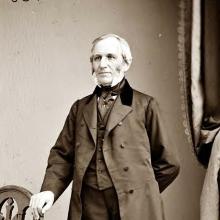
Willard Parker was born on September 2, 1800 in Lyndeborough, Hillsborough County, New Hampshire, United States. He was the son of a farmer, Jonathan Parker (born on June 10, 1764) by his wife, Hannah Clark (born on May 8, 1770). His paternal ancestor, Joseph Parker, had settled in Middlesex County, Massachussets, in 1640. Willard was named for his grandfather, Willard Parker, a descendant of Major Simon Willard. His great-uncle, Colonel Moses Parker, was fatally wounded at Bunker Hill, and his maternal grandfather, Reverend Peter Clark, fought in the War of the Revolution.
Education
Willard Parker received his primary education in a rural school, and obtained the degree of Bachelor of Arts at Harvard in 1826, having supported himself during his years at college. Through a chance contact with John Collins Warren, he was diverted from the ministry and took up the study of medicine. He was apprenticed to Doctor Warren and Doctor S. D. Townsend in Boston, attended medical lectures at Cambridge, and graduated Doctor of Medicine from Harvard in 1830, presenting an inaugural dissertation entitled "A Thesis on Nervous Respiration" (unpublished).
Career
During the next eight years (1830 - 1838) he held a succession of titles in various schools: professor of anatomy and surgery, Clinical School of Medicine, Woodstock, Vermont, a part of Waterville College, Maine (1830 - 1833), professor of surgery, Berkshire Medical Institution (1833 - 1836), professor of anatomy, Geneva, New York (1834 - 1836), professor of surgery, Cincinnati (1836 - 1837). He obtained a second doctorate of medicine from the Berkshire Medical Institution. In 1839 he was appointed professor of principles and practice of surgery in the College of Physicians and Surgeons, New York City, and held this post until 1870. In 1837 Parker went abroad and had a year at Paris, "walking" the wards of the great hospitals in contact with Chomel, Louis, and other stimulating French clinicians of that period. His excellent diary of this trip has been preserved by his descendants and was published by Ruhräh in the Annals of Medical History, May-September 1933. It gives an intimate picture of his experiences, and illustrates his personal characteristics.
On returning to New York, Willard Parker developed a large practice in the field of general surgery and became influential in public affairs. In surgery he was courageous and successful. He is credited with having performed cystotomy for irritable bladder (1850), with having tied the subclavian artery for aneurysm on five occasions (1864), and with having been the first in America to operate successfully upon an abscessed appendix. Though Hancock had operated for appendicitis in London in 1848, Parker was unaware of the fact; his contribution was bold and original and it received the enthusiastic commendation of Reginald Heber Fitz, who first established appendicitis as a clinical and pathological entity. Parker was also an inspiring teacher, lecturing for many years before crowded classrooms on the principles of surgery. He was president of the New York Academy of Medicine in 1856, and was affiliated with the New York, St. Luke's, Roosevelt, and Mount Sinai hospitals.
In 1870 he resigned from official responsibilities and became emeritus professor of surgery. Willard Parker died on April 25, 1884.
Achievements
Willard Parker was a distinguished professor of surgery in the College of Physicians and Surgeons, which position he held for 30 years. He was the first to point out a condition which is known as concussion of the nerves, as distinguished from concussion of the nerve centres, and which had been previously mistaken for one of inflammation. The Willard Parker Hospital for Infectious Diseases in New York was named in his honor.
Views
In public life Willard Parker was an active promoter of the temperance movement, despite the fact that he drank in moderation himself.
Personality
Personally, Willard Parker had a commanding but kindly presence which won the confidence and sympathy of both students and patients.
Connections
Willard Parker married on June 21, 1831, Caroline Sarah, daughter of Doctor Luther Allen of Stirling, Massachussets. There were two children by this marriage. His second wife was Mary Ann (Bissell) Coit, daughter of Josiah and Henrietta Perkins Bissell, whom he married May 25, 1844, and by whom he had one son and two daughters.