

Background
Quine, Willard Van Orman was born on June 25, 1908 in Akron, Ohio, United States. Son of Cloyd Robert and Hattie Ellis (Van Orman) Quine.

( This is an extensively revised edition of Mr. Quine's i...)
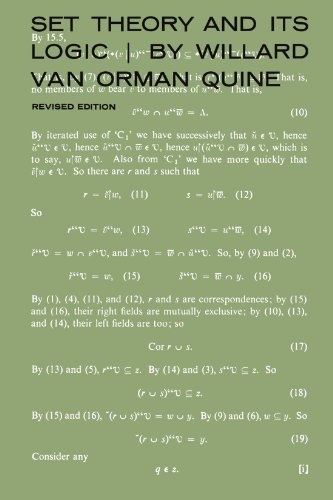
This is an extensively revised edition of Mr. Quine's introduction to abstract set theory and to various axiomatic systematizations of the subject. The treatment of ordinal numbers has been strengthened and much simplified, especially in the theory of transfinite recursions, by adding an axiom and reworking the proofs. Infinite cardinals are treated anew in clearer and fuller terms than before. Improvements have been made all through the book; in various instances a proof has been shortened, a theorem strengthened, a space-saving lemma inserted, an obscurity clarified, an error corrected, a historical omission supplied, or a new event noted.
http://www.amazon.com/gp/product/0674802063/?tag=2022091-20
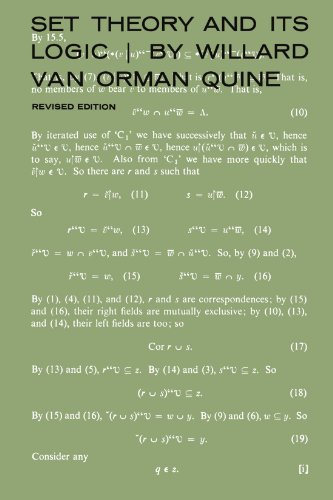
( This is an extensively revised edition of Mr. Quine's ...)
This is an extensively revised edition of Mr. Quine's introduction to abstract set theory and to various axiomatic systematizations of the subject. The treatment of ordinal numbers has been strengthened and much simplified, especially in the theory of transfinite recursions, by adding an axiom and reworking the proofs. Infinite cardinals are treated anew in clearer and fuller terms than before. Improvements have been made all through the book; in various instances a proof has been shortened, a theorem strengthened, a space-saving lemma inserted, an obscurity clarified, an error corrected, a historical omission supplied, or a new event noted.
http://www.amazon.com/gp/product/0674802071/?tag=2022091-20
(Brand New. Ship worldwide)
Brand New. Ship worldwide
http://www.amazon.com/gp/product/8430905138/?tag=2022091-20
(With his customary incisiveness, W. V. Quine presents log...)
With his customary incisiveness, W. V. Quine presents logic as the product of two factors, truth and grammar--but argues against the doctrine that the logical truths are true because of grammar or language. Rather, in presenting a general theory of grammar and discussing the boundaries and possible extensions of logic, Quine argues that logic is not a mere matter of words.
http://www.amazon.com/gp/product/0674665635/?tag=2022091-20
(Shipped from UK, please allow 10 to 21 business days for ...)
Shipped from UK, please allow 10 to 21 business days for arrival. Second edition. Minor shelfwear to covers and extremities of book, contents fine.
http://www.amazon.com/gp/product/0394321790/?tag=2022091-20
http://www.amazon.com/gp/product/B01181POTQ/?tag=2022091-20
http://www.amazon.com/gp/product/B0092J1QDA/?tag=2022091-20
http://www.amazon.com/gp/product/B00Y4RJ8IU/?tag=2022091-20
(book)
book
http://www.amazon.com/gp/product/B0006CF5XY/?tag=2022091-20

( In Pursuit of Truth W. V. Quine gives us his latest wor...)
In Pursuit of Truth W. V. Quine gives us his latest word on issues to which he has devoted many years. As he says in the preface: "In these pages I have undertaken to update, sum up, and clarify my variously intersecting views on cognitive meaning, objective reference, and the grounds of knowledge?' The pursuit of truth is a quest that links observation, theory, and the world. Various faulty efforts to forge such links have led to much intellectual confusion. Quine's efforts to get beyond the confusion begin by rejecting the very idea of binding together word and thing, rejecting the focus on the isolated word. For him, observation sentences and theoretical sentences are the alpha and omega ofthe scientific enterprise. Notions like "idea" and "meaning" are vague, but a sentence-now there's something you can sink your teeth into. Starting thus with sentences, Quine sketches an epistemological setting for the pursuit of truth. He proceeds to show how reification and reference contribute to the elaborate structure that can indeed relate science to its sensory evidence.In this book Quine both summarizes and moves ahead. Rich, lively chapters dissect his major concerns-evidence, reference, meaning, intension, and truth. "Some points;' he writes, "have become clearer in my mind in the eight years since Theories and Things. Some that were already clear in my mind have become clearer on paper. And there are some that have meanwhile undergone substantive change for the better." This is a key book for understanding the effort that a major philosopher has made a large part of his life's work: to naturalize epistemology in the twentieth century. The book is concise and elegantly written, as one would expect, and does not assume the reader's previous acquaintance with Quine's writings. Throughout, it is marked by Quine's wit and economy of style.
http://www.amazon.com/gp/product/0674739515/?tag=2022091-20
http://www.amazon.com/gp/product/B011DC3DNO/?tag=2022091-20
http://www.amazon.com/gp/product/B000UVDIIU/?tag=2022091-20

(Now much revised since its first appearance in 1941, this...)
Now much revised since its first appearance in 1941, this book, despite its brevity, is notable for its scope and rigor. It provides a single strand of simple techniques for the central business of modern logic. Basic formal concepts are explained, the paraphrasing of words into symbols is treated at some length, and a testing procedure is given for truth-function logic along with a complete proof procedure for the logic of quantifiers. Fully one third of this revised edition is new, and presents a nearly complete turnover in crucial techniques of testing and proving, some change of notation, and some updating of terminology. The study is intended primarily as a convenient encapsulation of minimum essentials, but concludes by giving brief glimpses of further matters.
http://www.amazon.com/gp/product/0674244516/?tag=2022091-20
http://www.amazon.com/gp/product/B009Z3Q06Q/?tag=2022091-20
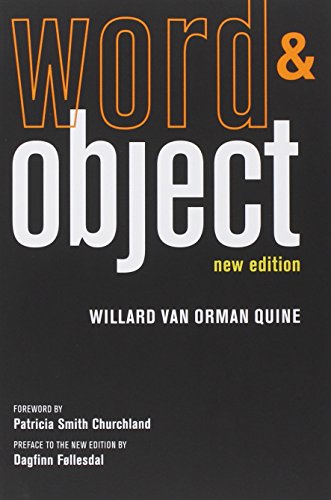
( Willard Van Orman Quine begins this influential work by...)
Willard Van Orman Quine begins this influential work by declaring, "Language is a social art. In acquiring it we have to depend entirely on intersubjectively available cues as to what to say and when." As Patricia Smith Churchland notes in her foreword to this new edition, with Word and Object Quine challenged the tradition of conceptual analysis as a way of advancing knowledge. The book signaled twentieth-century philosophy's turn away from metaphysics and what Churchland calls the "phony precision" of conceptual analysis. In the course of his discussion of meaning and the linguistic mechanisms of objective reference, Quine considers the indeterminacy of translation, brings to light the anomalies and conflicts implicit in our language's referential apparatus, clarifies semantic problems connected with the imputation of existence, and marshals reasons for admitting or repudiating each of various categories of supposed objects. In addition to Churchland's foreword, this edition offers a new preface by Quine's student and colleague Dagfinn Follesdal that describes the never-realized plans for a second edition of Word and Object, in which Quine would offer a more unified treatment of the public nature of meaning, modalities, and propositional attitudes.
http://www.amazon.com/gp/product/0262518317/?tag=2022091-20
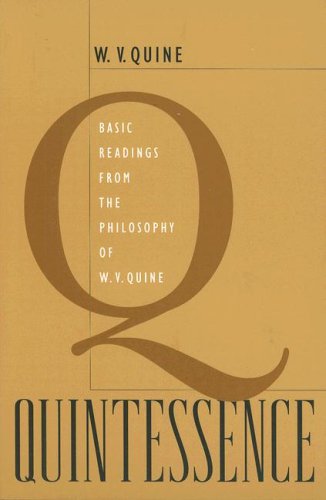
( Through the first half of the twentieth century, analyt...)
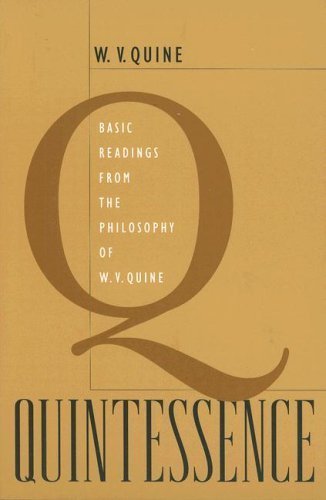
Through the first half of the twentieth century, analytic philosophy was dominated by Russell, Wittgenstein, and Carnap. Influenced by Russell and especially by Carnap, another towering figure, Willard Van Orman Quine (1908–2000) emerged as the most important proponent of analytic philosophy during the second half of the century. Yet with twenty-three books and countless articles to his credit―including, most famously, Word and Object and "Two Dogmas of Empiricism"―Quine remained a philosopher's philosopher, largely unknown to the general public. Quintessence for the first time collects Quine's classic essays (such as "Two Dogmas" and "On What There Is") in one volume―and thus offers readers a much-needed introduction to his general philosophy. Divided into six parts, the thirty-five selections take up analyticity and reductionism; the indeterminacy of translation of theoretical sentences and the inscrutability of reference; ontology; naturalized epistemology; philosophy of mind; and extensionalism. Representative of Quine at his best, these readings are fundamental not only to an appreciation of the philosopher and his work, but also to an understanding of the philosophical tradition that he so materially advanced.
http://www.amazon.com/gp/product/0674027558/?tag=2022091-20
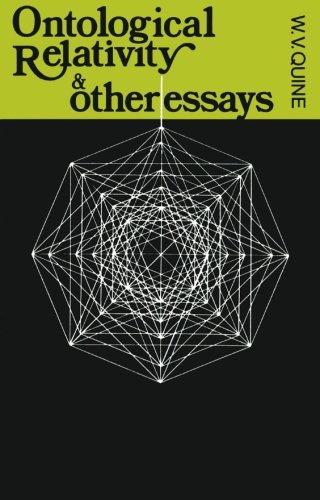
( This volume consists of the first of the John Dewey Lec...)
This volume consists of the first of the John Dewey Lectures delivered under the auspices of Columbia University's Philosophy Department as well as other essays by the author. Intended to clarify the meaning of the philosophical doctrines propounded by W. V. Quine in Word and Objects, the essays included herein are intimately related and concern themselves with three philosophical preoccupations: the nature of meaning, the meaning of existence and the nature of natural knowledge.
http://www.amazon.com/gp/product/0231083572/?tag=2022091-20
http://www.amazon.com/gp/product/B000VI9520/?tag=2022091-20
(A compact, coherent introduction to the study of rational...)
A compact, coherent introduction to the study of rational belief, this text provides points of entry to such areas of philosophy as theory of knowledge, methodology of science, and philosophy of language. The book is accessible to all undergraduates and presupposes no philosophical training.
http://www.amazon.com/gp/product/0075536099/?tag=2022091-20
("Our only channel of information about the world is the i...)
"Our only channel of information about the world is the impact of external forces on our sensory surfaces. So says science itself. There is no clairvoyance. How, then, can we have parlayed this meager sensory input into a full-blown scientific theory of the world? This is itself a scientific question. The pursuit of it, with free use of scientific theory, is what I call naturalized epistemology. The Roots of Reference falls within that domain. Its more specific concern, within that domain, is reference to concrete and abstract objects: what such reference consists in, and how we achieve it. "Part I is a statement of general psychological presumptions regarding perception and learning. The underlying notions of cause and disposition are examined in a philosophical spirit. In Part II those considerations are brought to bear more particularly on the learning of language. "Part II comes firmly to grips with the nature of reification and reference. The process is inseparable from language, and unequivocally identifiable only to the degree that the language resembles ours in certain structural respects. Stages of reification are sorted out, rudimentary to full-fledged. The full phase is heralded by the use of the relative clause with its relative pronoun and subsidiary pronouns. It is these pronouns that recur in logical notation as the bound variables of quantification. "Part III concludes with a conjectural sketch of the development of reification in the race and the individual. Especial attention is directed to the positing of abstract objects: properties, classes, numbers. It is traced in large part to the serendipity of fruitful confusions. Truth, after all, can issue fromfallacious proofs; to condemn the outcome for its fallacious origin is simply to add the genetic fallacy to what had gone before. Let us count our blessings".
http://www.amazon.com/gp/product/0812691016/?tag=2022091-20
(Quine ist ein Klassiker der Gegenwartsphilosophie. Doch Q...)
Quine ist ein Klassiker der Gegenwartsphilosophie. Doch Quine erl?utert nichts und erkl?rt wenig. Der von ihm angenommene Leser etwa seiner ber?hmten Aufsatz-Sammlung "From a Logical Point of View" ist der Fachkollege, der ebenso wie Quine die jeweilige aktuelle Debatte genau kennt. Die vorliegende zweisprachige und vor allem vollst?ndig durchkommentierte Ausgabe legt drei seiner wichtigsten Aufs...
http://www.amazon.com/gp/product/B00FKYN92C/?tag=2022091-20
(1)
1
http://www.amazon.com/gp/product/B00ZVOEODE/?tag=2022091-20
http://www.amazon.com/gp/product/B008UB3QOS/?tag=2022091-20
http://www.amazon.com/gp/product/B002G13SSC/?tag=2022091-20
http://www.amazon.com/gp/product/B008VRWK3O/?tag=2022091-20
(Book by Quine, Willard Van Orman)
Book by Quine, Willard Van Orman
http://www.amazon.com/gp/product/0674554515/?tag=2022091-20
http://www.amazon.com/gp/product/B01181OWLM/?tag=2022091-20
http://www.amazon.com/gp/product/B000SYC98E/?tag=2022091-20
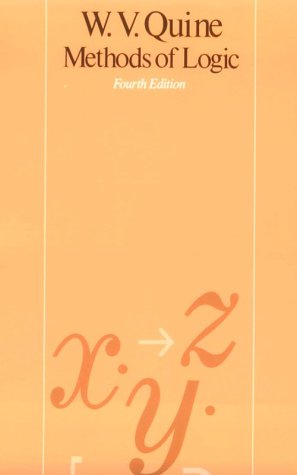
(This widely used textbook of modern formal logic now offe...)
This widely used textbook of modern formal logic now offers a number of new features. Incorporating updated notations, selective answers to exercises, expanded treatment of natural deduction, and new discussions of predicate- functor logic and the affinities between higher set theory and the elementary logic of terms, Quine's new edition will serve admirably both for classroom and for independent use.
http://www.amazon.com/gp/product/0674571762/?tag=2022091-20

http://www.amazon.com/gp/product/315018486X/?tag=2022091-20
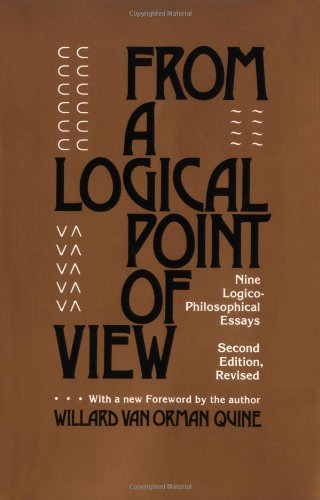
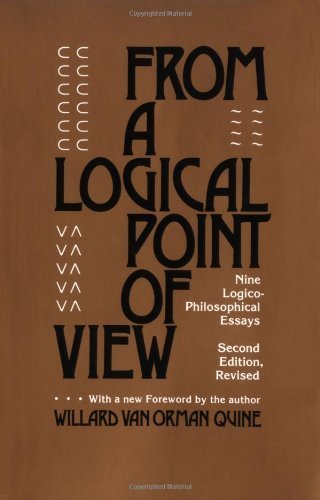
(These nine essays are largely concerned with the theory o...)
These nine essays are largely concerned with the theory of meaning and references―semantics. At the same time adjacent portions of philosophy and logic are discussed. To the existence of what objects may a given scientific theory be said to be committed? And what considerations may suitably guide us in accepting or revising such ontological commitments? These are among the questions dealt with in this book, particular attention being devoted to the role of abstract entities in mathematics. There is speculation on the mechanism whereby objects of one sort or another come to be posited, a process in which the notion of identity plays an important part.
http://www.amazon.com/gp/product/0674323513/?tag=2022091-20
http://www.amazon.com/gp/product/B011SJ8ALM/?tag=2022091-20

( The appellation "polymath" is often lightly bestowed, b...)
The appellation "polymath" is often lightly bestowed, but it can be applied with confidence to the celebrated philosopher Willard Van Orman Quine. Quine's areas of interest are panoramic, as this lively book amply demonstrates. Moving from A (alphabet) to Z (zero), Quiddities roams through more than eighty topics, each providing a full measure of piquant thought, wordplay, and wisdom, couched in easy and elegant prose--"Quine at his unbuttoned best," in Donald Davidson's words. Philosophy, language, and mathematics are the subjects most fully represented; tides of entries include belief, communication, free will, idiotisms, longitude and latitude, marks, prizes, Latin pronunciation, tolerance, trinity. Even the more technical entries are larded with homely lore, anecdote, and whimsical humor. Quiddities will be a treat for admirers of Quine and for others who like to think, who care about language, and who enjoy the free play of intellect on topics large and small. For this select audience, it is an ideal book for browsing.
http://www.amazon.com/gp/product/0674743520/?tag=2022091-20
http://www.amazon.com/gp/product/B0007DKEYC/?tag=2022091-20
(2013 Reprint of 1960 Edition. Full facsimile of the origi...)
2013 Reprint of 1960 Edition. Full facsimile of the original edition, not reproduced with Optical Recognition Software. Willard Van Orman Quine begins this influential work by declaring, "Language is a social art. In acquiring it we have to depend entirely on intersubjectively available cues as to what to say and when." With "Word and Object" Quine challenged the tradition of conceptual analysis as a way of advancing knowledge. The book signaled twentieth-century philosophy's turn away from metaphysics and what has been called the "phony precision" of conceptual analysis. In the course of his discussion of meaning and the linguistic mechanisms of objective reference, Quine considers the indeterminacy of translation, brings to light the anomalies and conflicts implicit in our language's referential apparatus, clarifies semantic problems connected with the imputation of existence, and marshals reasons for admitting or repudiating each of various categories of supposed objects. A profoundly influential work.
http://www.amazon.com/gp/product/1614275254/?tag=2022091-20

( This expanded edition of The Ways of Paradox includes p...)
This expanded edition of The Ways of Paradox includes papers that are among Professor Quine's most important and influential, such as "Truth by Convention," "Carnap and Logical Truth," "On Carnap's Views on Ontology," "The Scope and Language of Science," and "Posits and Reality." Many of these essays deal with unresolved issues of central interest to philosophers today. About half of them are addressed to "a wider public than philosophers." The remainder are somewhat more professional and technical. This new edition of The Ways of Paradox contains eight essays that appeared after publication of the first edition, and it retains the seminal essays that must be read by anyone who seeks to master Quine's philosophy. Quine has been characterized, in The New York Review of Books, as "the most distinguished American recruit to logical empiricism, probably the contemporary American philosopher most admired in the profession, and an original philosophical thinker of the first rank." His "philosophical innovations add up to a coherent theory of knowledge which he has for the most part constructed single-handed." In The Ways of Paradox new generations of readers will gain access to this philosophy.
http://www.amazon.com/gp/product/0674948378/?tag=2022091-20
( W. V. Quine is one of the most eminent philosophers ali...)
W. V. Quine is one of the most eminent philosophers alive today. Now in his mid-eighties he has produced a sharp, sprightly book that encapsulates the whole of his philosophical enterprise, including his thinking on all the key components of his epistemological stance--especially the value of logic and mathematics. New readers of Quine may have to go slowly, fathoming for themselves the richness that past readers already know lies between these elegant lines. For the faithful there is much to ponder. In this short book, based on lectures delivered in Spain in 1990, Quine begins by locating his work historically. He provides a lightning tour of the history of philosophy (particularly the history of epistemology), beginning with Plato and culminating in an appreciative sketch of Carnap's philosophical ambitions and achievements. This leads, in the second chapter, to an introduction to Quine's attempt to naturalize epistemology, which emphasizes his continuities with Carnap rather than the differences between them. The next chapters develop the naturalistic story of the development of science to take account of how our conceptual apparatus is enhanced so that we can view the world as containing re-identifiable objects. Having explained the role of observation sentences in providing a checkpoint for assessing scientific theories, and having despaired of constructing an empirical criterion to determine which sentences are meaningful, Quine in the remaining chapters takes up a variety of important issues about knowledge. He concludes with an extended treatment of his views about reference and meaning and his attitudes toward psychological and modal notions. The presentation is distinctive, and the many small refinements of detail and formulation will fascinate all who know Quine's philosophy.
http://www.amazon.com/gp/product/0674326369/?tag=2022091-20
http://www.amazon.com/gp/product/B01181OXHU/?tag=2022091-20
Quine, Willard Van Orman was born on June 25, 1908 in Akron, Ohio, United States. Son of Cloyd Robert and Hattie Ellis (Van Orman) Quine.
Bachelor of Arts in Mathematics, summa cum laude, Oberlin College, 1930. Master of Arts in Philosophy, Harvard University, 1931. Doctor of Philosophy, Harvard University, 1932.
Master of Arts, Oxford University, 1953. Doctor of Letters (honorary), Oberlin College, 1955. Doctor of Letters (honorary), Ohio State University, 1957.
Doctorate (honorary), University Lille, France, 1965. Doctor of Letters (honorary), Akron University, 1965. Doctor of Letters (honorary), Washington University, St. Louis, 1966.
Doctor of Humane Letters (honorary), University Chicago, 1967. Doctor of Letters (honorary), Oxford University, 1970. Doctor of Letters (honorary), Temple University, 1970.
Doctor of Letters (honorary), Cambridge University, England, 1978. Doctor of Laws (honorary), Harvard University, 1979. Doctor of Philosophy (honorary), Uppsala University, Sweden, 1980.
Doctor of Letters, Syracuse University, 1981. Doctorate, University Berne, Switzerland, 1982. Doctor of Humane Letters (honorary), Ripon College, 1983.
Doctor of Philosophy (honorary), University Granada, Spain, 1986. Doctor of Humane Letters (honorary), Adelphi University, 1989.
Fellow, Society of Fellows, Harvard 1933-1936, Faculty Instructor in Philosophy 1936-1941, Association Professor 48, Professor, of Philosophy 1948-1956, Edgar Pierce Professor, of Philosophy, Harvard University 1956-1978, Emeritus Professor since 1978. United States.N.R. 1942-1946. Visiting Professor University of Sao Paulo, Brazil 1942, George Eastman Visiting Professor, Oxford University 1953-1954.
Shearman Lecturer, University of London 1954.
President Association for Symbolic Logic 1953-1955. Fellow, Center for Advanced Study in Behavioral Sciences, Stanford 1958-1959.
Gavin David Young Lecturer, Adelaide University, Australia 1959. Visiting Professor Tokyo University 1959.
Fellow, Wesleyan University Center for Advanced Study 1965.
Fellow, American Academy, of Arts and Sciences, North.A.S., American Philosophical Society. Correspondent Fellow British Academy, Norwegian Academy. Correspondent; Lecturer, New York 1971, Saville Fellow, Oxford 1973-1974.
President American Philosophical Association 1958.
( This expanded edition of The Ways of Paradox includes p...)
(A compact, coherent introduction to the study of rational...)
( This volume consists of the first of the John Dewey Lec...)
( The appellation "polymath" is often lightly bestowed, b...)
(Now much revised since its first appearance in 1941, this...)
( Through the first half of the twentieth century, analyt...)
( Language consists of dispositions, socially instilled, ...)
("Our only channel of information about the world is the i...)
(Here are the most recent writings, some of them unpublish...)
( Willard Van Orman Quine begins this influential work by...)
(These nine essays are largely concerned with the theory o...)
(This widely used textbook of modern formal logic now offe...)
(Shipped from UK, please allow 10 to 21 business days for ...)
(Quine ist ein Klassiker der Gegenwartsphilosophie. Doch Q...)
( How we acquire our theory of the world is for W. V. Qui...)
( This is an extensively revised edition of Mr. Quine's i...)
( This is an extensively revised edition of Mr. Quine's ...)
( This is an extensively revised edition of Mr. Quine's i...)
(With his customary incisiveness, W. V. Quine presents log...)
(For more than two generations, W. V. Quine has contribute...)
(Book by Quine, Willard Van Orman)
(2013 Reprint of 1960 Edition. Full facsimile of the origi...)
(Will be shipped from US. Used books may not include compa...)
( In Pursuit of Truth W. V. Quine gives us his latest wor...)
(In Pursuit of Truth W. V. Quine gives us his latest word ...)
(Brand New. Ship worldwide)
(book)
(New)
( W. V. Quine is one of the most eminent philosophers ali...)
(1)
Served to Lieutenant commander of The United States Navy Reserve, 1942-1946. Fellow American Philosophical Society, British Academy (correspondent). Member American Philosophical Association (president East division 1957), Association Symbolic Logic (president 1953-1956), American Academy Arts and Sciences, National Academy Sciences, Institut de France (correspondent), Norwegian Academy, Institut International de Philosophie, Instituto Brasileiro de Filosofia (correspondent), Academie Internationale de la Philosophie de Science, Phi Beta Kappa.
Married Naomi Ann Clayton, September 19, 1930. Children: Elizabeth Roberts, Norma. Married Marjorie Boynton, September 2, 1948.
Children: Douglas Boynton, Margaret McGovern.


