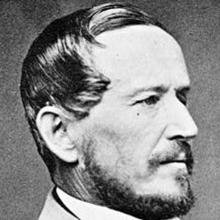
William Wirt Adams was an American banker, planter and state legislator. He also served as a Brigadier-General in the Confederate States Army.
Background
William Wirt Adams was born on March 22, 1819 at Frankfort, Kentucky, United States. He was the son of Judge George Adams and Anna Weisiger Adams. Judge Adams was an intimate friend and correspondent of Henry Clay.
In 1825 he moved from Kentucky and located at Natchez, Mississippi; from 1836 to 1839 he was the judge of the United States court for Mississippi.
Education
William Wirt Adams was educated at Bardstown College, Kentucky, graduating in 1839.
Career
In 1839 Adams enlisted as a private in Colonel Burleson's command for service to the Republic of Texas and soon afterward was made adjutant of the regiment and was in the campaign against the Indians in northeast Texas. In the autumn of 1839, he returned to Mississippi.
In 1850 he was engaged in planting and banking at Jackson and Vicksburg.
From 1850 to 1861 he was occupied in a successful business career and served two sessions in 1858 and 1860 as a member of the Mississippi legislature. When Mississippi withdrew from the Union in 1861, he was appointed commissioner from Mississippi to Louisiana and assisted in securing the withdrawal of that state from the Union.
In February 1861, upon the formation of the Confederate States of America at Montgomery, Alabama, he was called to Montgomery by President Jefferson Davis and offered the cabinet position of postmaster general, which he felt compelled to decline.
As soon as he had settled his banking interests, he raised a cavalry regiment and enlisted it in the Confederate Army as the 1st Mississippi Cavalry. It was also officially known as Wirt Adams's Regiment of Cavalry. The regiment was organized at Memphis, in August 1861. The command was ordered to Columbus, Kentucky, in September, and in October to the headquarters of Gen. Albert Sidney Johnston at Bowling Green. The regiment was the rear-guard in the retreat from Kentucky to Nashville and Corinth.
At the battle of Shiloh Adams's regiment was stationed upon the extreme right, near Greer's Ford of the Tennessee River, and accompanied the infantry line into battle. During the Corinth campaign, the regiment was on outpost duty. After the retreat to Tupelo, four companies of the regiment had a spirited engagement with the enemy near Booneville, "charging, routing, and pursuing two miles a Federal regiment" under command of Major Philip Sheridan.
Colonel Adams with his own and Slemons' Arkansas regiment was at Iuka with General Price, and near Burnsville captured a train-load of Federal troops sent out from Corinth. He was then ordered to Washington County, Mississippi, guarding the plantations and observing the movements against Vicksburg. When Sherman advanced against Jackson after the fall of Vicksburg, Adams, with his regiment and the 28th Mississippi Cavalry, harassed his advance, skirmishing all the way.
Being commissioned brigadier-general in September 1863, in November Adams was assigned to the command of a brigade composed of his own regiment and Colonel Logan's command.
In February 1864, he was ordered to meet Sherman's advance on Meridian. When the end came he was operating with Gen. Forrest in north Alabama. Adams's brigade was surrendered near Ramsey Station, Sumpter County, Alabama, May 4, 1865. His farewell address was delivered to his command on May 6, 1865. His parole is dated Gainesville, Alabama, May 12, 1865.
After the war, Adams resided at Vicksburg and later in Jackson. He was appointed state revenue agent in 1880 and resigned in 1885 to become post-master at Jackson by appointment of President Cleveland.
On May 1, 1888, in a street encounter with John Martin, a Jackson editor who had bitterly criticized Adams in his paper, both Adams and Martin were killed.
Achievements
William Wirt Adams took part in numerous battles during the American Civil War. For his military service, Adams was commissioned as Brigadier General.
Adams has been listed as a noteworthy army officer by Marquis Who's Who.
Connections
In 1850 Adams was married to Sallie Huger Mayrant. They had five children.