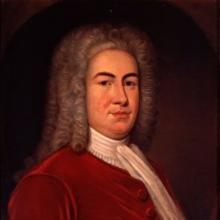
William Burnet was an American colonial governor. He is most noted for his service as a governor of New York and New Jersey (1720–1728), Massachusetts, and New Hampshire (1728–1729).
Background
William Burnet was born in March of 1688 at The Hague during his father's temporary residence there, was the son of Gilbert Burnet, the celebrated Bishop of Salisbury, and his second wife, Mary Scott. The Bishop was not only a man of intellectual distinction himself but had a wide acquaintance among men both of mind and action so that the atmosphere of the home into which the young William was born was one to stimulate his own abilities and ambition.
Education
He was, however, by no means a model student, and, although he entered Trinity College, Cambridge, at thirteen, he was soon removed for "idleness and disobedience. " He then received private instruction from tutors and was subsequently called to the bar.
Career
He was the godson of King William and Queen Mary and had numerous friends in high places. On April 19, 1720, he was appointed governor of New York and New Jersey. He promptly sailed from England on July 10 and arrived at New York on September 16. Both at this post and at his subsequent one in Massachusetts, his record was an honorable one.
New York, owing to its geographical position with relation to the French in Canada by way of Lake Champlain, and to the Indian fur trade routes to the westward through the Mohawk Valley, was the key colony in regard to the entire colonial Indian policy. Burnet at once sensed the importance of the Indian problem. The English were able to import the goods used in the Indian trade to purchase furs at much lower prices than could the French at Montreal, and this should have given them a great advantage in dealing with the savages.
But although the New Yorkers held a powerful weapon in their hands in the cheapness of their trading goods, this was blunted to a great extent by the fact that there were important merchants who found it more profitable and easier to sell their goods to the French than to trade them with the Indians. Burnet realized that by this French trade the English were handing their strongest weapon to their enemies.
The English government transferred him to Massachusetts and he left for Boston soon after the arrival of his successor on April 15, 1728. The few months which were left to him before death were marked by the culmination of the contest between the Massachusetts Assembly and governor over the salary question. The argument took constitutional ground and both sides stated their positions, which were irreconcilable, with greater clearness and fulness than at any other point in the interminable wrangle.
Burnet's stand was honorable throughout and in no way dictated by avarice, from which vice he was entirely free. Worn out by the work of his office, he died September 7, 1729.
Achievements
Burnet was distinctly above the average of colonial governors. His most important accomplishment as governor was to strengthen the colony's position on the frontier. Along with this initiative, he strengthened outposts like Fort Oswego and it was considered as an effective strategy.
Governor Burnet encouraged direct trade with Indian tribes to reduce the influence of French traders, since many of the goods bartered with the Indians for furs were produced locally, while the French imported theirs so the colonists could undercut French prices.
Also, it was under his initiative a meeting at Albany in 1722 was convened gathering representatives from several colonies. That resulted in peace with Indian tribes for several years.
Views
He was able, cultivated, charitable, just, genuinely solicitous to promote the welfare of the provinces he governed and not unwilling to make personal sacrifices for their good.
It was his endeavor to prevent this and to rectify the Indian policy of the English which furnished the main-spring of his policy as governor. In his first year he secured the passage of a law prohibiting the Canadian trade and subsequently established a trading post at Tirondequot where goods were sold to the savages at half the price at which the French sold them. His Indian policy was not without mistakes in detail but was wise and farsighted in principle. He at once, of course, came into conflict with powerful mercantile forces which cared more for their private gain than for the public benefit. His struggle with certain mercantile groups and with the Assembly became increasingly bitter.
He made enemies of such powerful families as the Philipses and De Lanceys, and his action in setting up a court of chancery was roundly denounced by the Assembly in 1727. His struggles with the Assemblies were always for principles and not for personal advantage.
Membership
He became a member of the Royal Society in February 1705/6.
Personality
Burnet was a man of ability who had his own way to make in the world.
Connections
About May 1712 he made an imprudent love-match with a daughter of Dean Stanhope, his wife dying within three years from a broken heart, it was said, due to a previous attachment. While serving as a governor of New York, he had married Anna Maria (Mary) Van Horne, daughter of Abraham Van Horne and Mary Prevoost of that city.
Father:
Gilbert Burnet
Bishop
Mother:
Mary Scott
Wife:
Anna Maria (Mary) Van Horne
Friend:
Robert Hunter
He kept corresponding with a longtime friend, Robert Hunter, who returned to England in 1719.