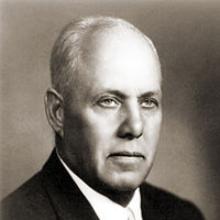
William George Meany was born on August 16, 1894 in Harlem in New York City. He was the second of eight surviving children of Michael Joseph Meany, a plumber and union official, and Anne Cullen. At age five, George Meany (his given first name was never used) moved with his family to the Bronx. His father died suddenly in 1916, and when the United States entered World War I in April 1917, Meany's older brother John immediately enlisted in the army, leaving George Meany, at the age of twenty-two, as the sole provider for his mother and six younger siblings.
Education
Meany attended Public School 29 there from 1899 to 1908, and Morris High School the following year. Although a good student, Meany dropped out of school at the age of fourteen. In keeping with the values of the insular community in which he grew up, Meany followed in his father's footsteps by signing on in the fall of 1910 as an unskilled helper to a local plumber. At his father's insistence, Meany enrolled in a nearby trade school, where he studied plumbing at night for an academic year. Meany worked for another three years as a plumber's apprentice and then took the journeyman plumber's exam, which he passed on his second try in 1915.
Career
After a brief probationary period, Meany on January 10, 1917, became a full-fledged member of the Manhattan-Bronx local of the United Association of Journeymen and Apprentices of the Plumbing and Pipe Fitting Industry of the United States and Canada. At first, he showed relatively little interest in the union's affairs, preoccupied as he was with family responsibilities. As a journeyman plumber, Meany could command an hourly wage that was high enough to shoulder his considerable burden, but only if the work proved steady, which it seldom did. As a result, he had to supplement his income with money earned from playing semiprofessional baseball. By then a big, burly man, Meany earned something of a reputation as a nimble catcher. Soon after his marrying in 1919, George Meany became active in the plumbers' union local 463. A practical man, Meany may have been attracted by the higher pay and greater security of a union official's life. At least as important, however, appears to have been a growing awareness that he had the brains and ability to go farther. His wife, whose own union was then in a militant, organizing phase, also seems to have encouraged him. In September 1922, when a business agent's position opened in the local, Meany pursued it and again won, at which point he became a full-time union official.
Meany proved unusually adept at his new job, which consisted of monitoring contract compliance at job sites. Much of the work was essentially legalistic, and Meany soon developed what proved to be a lifelong interest in legal concepts and terminology. He first came to the attention of the plumbers' union leadership in 1927, when he took the then-heretical step, among older union officials at least, of seeking and winning a court injunction to defeat a lockout. He soon became secretary of the New York Building Trades Council, a job that provided only a nominal salary but enabled him to meet influential politicians and labor leaders, who were impressed by this well-dressed and well-spoken union official. In the late 1920's and early 1930's, Meany parlayed those attributes into a major advance within New York's trade-union hierarchy. First came his election in 1932 as one of the thirteen vice-presidents of the New York State Federation of Labor. Only two years later Meany was elected its president, a fortuitous time for labor leadership since the state legislature was then considering a whole host of bills labor wanted. By testifying before committees, making speeches, and dueling with reporters, Meany contributed significantly to the passage of groundbreaking workers' compensation, unemployment insurance, and health and safety laws. Meany also won praise for the way he handled the other parts of his job, most notably his dogged and clever bargaining with the city and federal officials over wage rates for public employees, and his ability to hold together New York's endlessly feuding building trades' unions. His record brought Meany to the attention of the American Federation of Labor, which by 1939 was looking to replace the aging and increasingly ineffective AFL secretary-treasurer, Frank Morrison. Meany's independence from the AFL's various power blocs and experience as lobbyist and spokesman struck AFL officials as the right credentials for the New Deal era. On October 12, 1939, the AFL's national convention ratified his appointment, and Meany was on his way to Washington and the national stage.
During World War II, Meany served as a permanent AFL representative on the National War Labor Board (NWLB), where he emerged as a blunt, tough spokesman for unions seeking wage increases. Although intimately involved in the crafting and passage of much so-called Great Society legislation in the mid-1960's, Meany by then had become a highly controversial figure within liberal circles. His early and vociferous support for American military intervention in Vietnam, which he saw as entirely consistent with the containment policy adopted in the late 1940's, alienated liberals and left-wing laborites. So, too, did his criticism of affirmative action programs aimed at compelling labor unions to set aside a certain number of jobs for nonwhites. Meany's inability to reverse the decline in the fraction of the work force organized into unions that had begun in the late 1950's, and seeming lack of interest even in trying to do so, also alienated labor militants, most notably United Auto Workers Union (UAW) president Walter Reuther. A product of the New Deal liberal era, Meany struck 1960's liberals and new leftists as increasingly dated and "conservative. " His resistance to wage-control policies and reservations about feminism as well as environmental legislation that cost jobs also hurt him among middle-class liberals. Meany's stodgy, rigid, and often dismissive manner contributed to his loss of prestige, as did his indifference to matters of image.
Meany's isolation from reform elements grew during his final decade as AFL-CIO president. Although labor strongly supported Jimmy Carter's election as president in 1976, Meany never enjoyed a real rapport with the Georgian, who showed little warmth to Meany the man, and failed to deliver the labor reform legislation that the AFL-CIO had wanted from the Carter administration. Increasingly feeble from severe arthritis in the late 1970's, Meany finally resigned his office and installed a handpicked successor in November 1979. Two months later he died of a heart attack in Washington, D. C.
Achievements
A controversial figure for most of his career and never more so than toward its end, Meany nonetheless proved to be one of the most influential labor leaders in American history. A moderate during a radical period in American labor history, Meany had contributed to the AFL's resurgence during the late 1930's in the face of a continuing challenge from the new Congress of Industrial Organizations (CIO), led by AFL renegade John L. Lewis. Meany's one other major achievement as AFL secretary-treasurer lay in the realm of political action. The AFL had traditionally pursued a policy of independence from all political parties, preferring instead an opportunistic neutrality. But with the Republican-controlled Eightieth Congress's passage of the Taft-Hartley Act in 1947, opposed by all labor leaders, support within the AFL for political neutrality suffered a mortal blow. Meany, determined to oust the GOP majorities in Congress, worked to establish Labor's League for Political Education (LLPE), which the AFL formally created in December 1947. Collaboration during 1948 between the CIO's Political Action Committee (PAC) and the LLPE proved instrumental in electing Truman to a full term in his own right, and in returning control of Congress to the Democrats. In recognition of Meany's record, the AFL elected him its president when incumbent William Green died in 1952. As AFL president Meany continued along the course he had charted in his lesser trade union roles. A strong opponent of labor corruption, he persuaded the AFL chieftains to expel the racketeer-influenced International Longshoremen's Association (ILA) in 1953, and several other corrupt affiliates, most notably the Teamsters union, several years later. He played a major part in the quest for labor unity, working out with CIO general counsel Arthur J. Goldberg the terms of the AFL merger with the CIO in 1955. With that development, Meany became president of the AFL-CIO and the undisputed spokesman for the American labor movement. Meany also expanded upon his earlier commitment to labor's participation in partisan politics following the AFL-CIO merger by persuading the federation to pursue an electoral alliance with the Democrats, and by establishing the Committee on Political Education (COPE), a permanent AFL-CIO vehicle for influencing the election of public officials. He played a similarly important part in winning federation support for civil rights legislation and court decisions aimed at dismantling legalized segregation.
President John F. Kennedy established the Presidential Medal of Freedom on February 22, 1963, but died before he could award it. Two weeks after Kennedy's assassination, President Lyndon Johnson awarded it to Meany and thirty others on December 6, 1963. Johnson said the award was for Meany's service to the union movement and for advancing freedom throughout the world.
On November 6, 1974, Meany dedicated the George Meany Center for Labor Studies (founded 1969), which was renamed the National Labor College in 1997. From 1993 to 2013, the college housed the George Meany Memorial Archives, held at the University of Maryland since 2013. The George Meany Award was established by the Boy Scouts of America in 1974. On the 1994 100th anniversary of his birth, Meany was pictured on a United States commemorative postage stamp
Politics
Meany was deeply concerned with foreign policy issues. Always hostile to Communists, he became ever more so during the war. In keeping with that view, Meany led the AFL boycott of the World Federation of Trade Unions (WFTU), formed in 1945, for its decision to admit Soviet trade unions. Attacking them as creatures of the Soviet state, Meany helped establish a rival federation, the International Confederation of Free Trade Unions (ICFTU), which eventually won the allegiance of all labor federations save those of the Soviet Union and its allies. Meany hailed the Truman administration's Cold War policies and strongly supported American military intervention in the Korean conflict. He blasted John L. Lewis in a memorable speech at the 1947 AFL convention for Lewis's willingness to work with American Communists.
Views
The most important influences upon the young Meany were trade unionism, partisan politics, Irish nationalism, and Roman Catholicism.
Quotations:
"Labor never quits. We never give up the fight - no matter how tough the odds, no matter how long it takes. "
"The basic goal of labor will not change. It is - as it has always been, and I am sure always will be - to better the standards of life for all who work for wages and to seek decency and justice and dignity for all Americans. "
"One cannot have a trade union or a democratic election without freedom of speech, freedom of association and assembly. Without a democratic election, whereby people choose and remove their rulers, there is no method of securing human rights against the state. No democracy without human rights, no human rights without democracy, and no trade union rights without either. That is our belief; that is our creed. "
"Every piece of progressive social legislation passed by Congress in the 20th century bears a union label. "
"Economics was the only profession where a person could be considered an expert without having once been right. "
"Anybody who has doubts about the ingenuity or the resourcefulness of a plumber never got a bill from one. "
"We heard from the abortionists and we heard from the people who looked like Jacks, acted like Jills and had the odors of Johns. "
"It is impossible to bargain collectively with the government. "
"The one profession where you can gain great eminence without ever being right. "
"The most persistent threat to freedom, to the rights of Americans, is fear. "
Personality
If formally only the chief clerk of a federation whose member unions had most of the real power, Meany proved adept at guiding them more like the head of a centralized western European labor movement than any other American labor leader, before or since. In many ways Meany was the prototype of the modern American labor leader: strongly supportive of a market system and firmly believing in the need for unions both to humanize and sustain it, militantly hostile to Communism as a betrayal of workers' highest aspirations, practical when dealing with employers and government officials but zealous in protecting unions' autonomy from both, and temperamentally committed to gradualist reform. The quintessential organization man, Meany was, as he himself sometimes reminded listeners, a labor leader who had never walked a picket line, organized a local, or led a strike. It was precisely those qualities that made him so novel, successful, and controversial a figure throughout his long career. Meany often appeared in public puffing on cigars, playing golf with influential politicians, and sunning himself during AFL-CIO conclaves at luxurious hotels in Bal Harbour, Fla. , images that undercut his credibility as a spokesman for the American working class.
Connections
On November 26, 1919, Meany was married to Eugenie Augustina McMahon, a clothing worker and member of the International Ladies' Garment Workers' Union. They had three children.