

Background
Browne, William P. was born on May 15, 1945 in Cherokee, Iowa, United States. Son of William Dale and Irene Etta Browne.
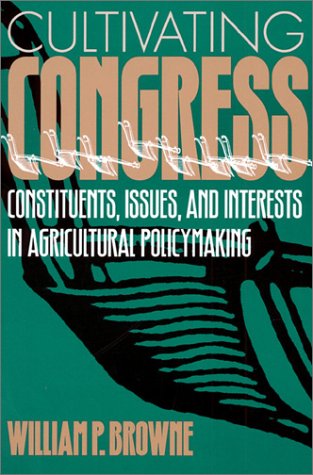
(Congress in the mid-1990s remains the object of voter dis...)
Congress in the mid-1990s remains the object of voter discontent. Public outcries against special interests and unresponsive incumbents have amplified an already pervasive skepticism toward Beltway politics. And while Congress continues to conduct its business, William Browne argues that it is no longer business as usual. Browne opens up the inner sanctums of Congress to reveal how that institution's daily operations-i.e., its policymaking processes-have changed dramatically. He argues that Congress is no longer dominated by party and committee power-brokers, large organized interest groups, or intrusive federal agencies. Instead, he contends, congressional members are driven largely by grassroots issues and constituent interests. This shift occurred in response to reforms that diluted the congressional seniority system and empowered the rank-and-file to exert greater influence in policymaking. More members now generate more issues much earlier in that process, resulting in a greater diversity of views in previously entrenched policy domains, but also greater disorganization and less predictability. Those changes are nowhere more apparent than in the ever shifting arena of agricultural policymaking, which, as the single largest contributor to our GNP, remains a central part of American politics. As agriculture has become more fragmented, globalized, and environmentally aware, agricultural policymaking has grown increasingly complex. In the process, a cacophony of constituent policy demands has altered the way congressional members "play the game." Browne reveals exactly how that new game is played. Based on nearly 450 interviews with members of Congress, their staff, agency administrators, and lobbyists, Browne's study is timed to appear during the 1995 Congressional debates over a major new agriculture bill. His book should become a major resource for congressional staff, journalists, political scientists, economists, lobbyists, and policy administrators for understanding those debates.
http://www.amazon.com/gp/product/0700607013/?tag=2022091-20
http://www.amazon.com/gp/product/B010WI5YIC/?tag=2022091-20
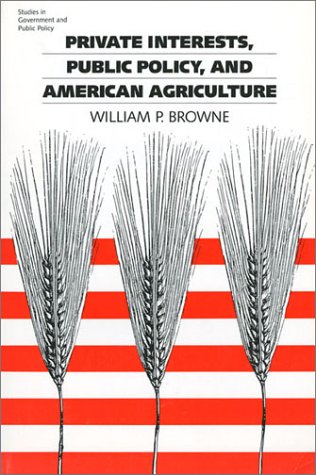
(Agriculture is at a critical juncture. The Food Security ...)
Agriculture is at a critical juncture. The Food Security Act of 1985, which was intended to reduce surpluses by making American farm products more competitive in world markets, has not yet succeeded. Food imports have outstripped food exports. Huge grain surpluses continue to pile up. Because many farmers and economists fault federal agricultural policies for the current predicament, this book examines how recent policies, like the 1985 law, have been made and focuses on the key role that private interests play in the policy process. Not only does Browne give us the first comprehensive study of all of the organized interests at work in agricultural policymaking, but he also makes an important contribution to understanding the interaction of organized interests in the American political process. His book should appeal to a wide audience composed of those interested in agriculture, policy process, and interest group behavior. In the early 1980s, 128 separate organizations employed Washington-based lobbyists who regularly worked to influence agricultural policies. Many other organizations periodically lobbied in agriculture. The general farm organizations have been joined by commodity organizations, trade associations, corporate spokesmen, farm activists, industry lobbyists, consumer groups, environmentalists, and advocates of a variety of food-related programs. Long gone are the days when the farm bloc preordained policy outcomes and when students of American politics looked upon agriculture as a classic example of the "iron triangle" or self-governing subsystem of interest groups, bureaucrats, and legislators. Now the policymaking process is fragmented by the clamor from competing organized interest groups, and the policy makers responded by fashioning piecemeal policy with no seeming thought to unity of purpose. In an attempt to throw light on what actually happens in Washington, Browne explains what groups and interests are active in agricultural policymaking, what strategy and tactics they employ, and why some have more influence than others. One of Browne's conclusions is that a surprising number of agricultural issues are uninfluenced by the interest groups because they ignore them. For nearly a decade William P. Browne has studied the major farm organizations, congressional hearings and records related to agricultural issues, and the American Agricultural Movement. But perhaps his richest source of information has been extensive interviews with lobbyists, executives, and grassroots activists during and just after the 1985 farm bill debates. In the course of his research, Browne sought to learn how interest groups behave in deciding their policy priorities and how this behavior actually relates to influence over the desired policy outcomes.
http://www.amazon.com/gp/product/0700603352/?tag=2022091-20

(Modern farm policy emerged in the United States in 1862, ...)
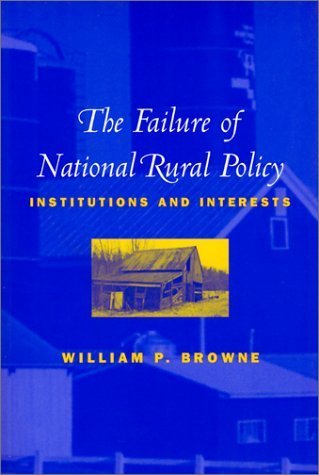
Modern farm policy emerged in the United States in 1862, leading to an industrialized agriculture that made the farm sector collectively more successful even as many individual farmers failed. Ever since, a healthy farm economy has been seen as the key to flourishing rural communities, and the problems of rural nonfarmers, former farmers, nonfarm residents, and unfarmed regions were ignored by policymakers. In The Failure of National Rural Policy, William P. Browne blends history, politics, and economics to show that federal government emphasis on farm productivity has failed to meet broader rural needs and actually has increased rural poverty. He explains how strong public institutions, which developed agrarianism, led to narrowed concepts of the public interest. Reviewing past efforts to expand farm policy benefits to other rural residents, Browne documents the fragmentation of farm policy within the agricultural establishment as farm services grew, the evolution of political turf protection, and the resultant difficulties of rural advocacy. Arguing for an integrated theory of governing institutions and related political interests, he maintains that nonfarm rural society can make a realistic claim for public policy assistance. Written informally, each chapter is followed by comments on the implications of its topics and summaries of key points. The book will serve as a stimulating text for students of public policy, national affairs, rural sociology, and community development―as well as anyone concerned with the future of agrarian America.
http://www.amazon.com/gp/product/0878408584/?tag=2022091-20
(Synthesizing theory, personal research, and prior studies...)
Synthesizing theory, personal research, and prior studies on interest groups and other lobbies, William P. Browne offers a new, insightful overview of organized political interests and explains how and why they affect public policy. Drawing on his extensive experience researching interest groups, Browne assesses the impact that special interests have long had in shaping policy. He explains how they fit into the policymaking process and into society, how they exercise their influence, and how they adapt to changing circumstances. Browne describes the diversity of existing interests-associations, businesses, foundations, churches, and others-and explores the multidimensional tasks of lobbying, from disseminating information through making financial contributions to cultivating the media. He shows how organized interests target not just the public and policymakers but even other interest groups, and how they create policy niches as a survival strategy. He also looks at winnable issues, contrasts them with more difficult ones, and explains what makes the difference. Groups, Interests, and U.S. Public Policy is a serious study written in a lighthearted tone. It offers political scientists a new theory of how and why interest groups influence public policy while it enlightens students and general readers about how policy is actually shaped in America.
http://www.amazon.com/gp/product/0878406824/?tag=2022091-20
Browne, William P. was born on May 15, 1945 in Cherokee, Iowa, United States. Son of William Dale and Irene Etta Browne.
Bachelor of Science, Iowa State University, 1967. Master of Science, Iowa State University, 1969. Doctor of Philosophy, Washington University, St. Louis, 1971.
Professor political science Center Michigan University, Mount Pleasant, Michigan, 1971—2004, professor emeritus, from 2004. Member advisory board Henry A. Wallace Institute, Winrock, Alabama, 1990-1996. Consultant agribusiness organization, non-profit institutions, since 1985.
(Modern farm policy emerged in the United States in 1862, ...)
(Synthesizing theory, personal research, and prior studies...)
(Congress in the mid-1990s remains the object of voter dis...)
(Agriculture is at a critical juncture. The Food Security ...)
Member American Political Science Association, American Agricultural Economics Association (Quality of Communications award 1993), Rural Sociological Society, American Society Public Administration, Midwest Political Science Association, Michigan Association Political Scientists (president 1983-1984), Policy Studies Organization (president 1999-2000).
Married Linda Sue Browne.
