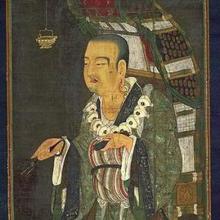
Xuanzang was Buddhist monk and Chinese pilgrim to India who translated the sacred scriptures of Buddhism from Sanskrit into Chinese and founded in China the Buddhist Consciousness Only school. His fame rests mainly on the volume and diversity of his translations of the Buddhist sutras and on the record of his travels in Central Asia and India, which has been of inestimable value to historians and archaeologists.
Background
Xuanzang displayed a superb intelligence and earnestness, amazing his father by his careful observance of the Confucian rituals at the age of eight. Although his household was essentially Confucian, at a young age, Xuanzang expressed interest in becoming a Buddhist monk as one of his elder brothers had done. After the death of his father in 611, he lived with his older brother Chen Su for five years at Jingtu Monastery in Luoyang, supported by the Sui Dynasty state. During this time he studied Mahayana Buddhism and various early Buddhist schools, preferring Mahayana.
In 618, the Sui Dynasty collapsed and Xuanzang and his brother fled to Chang'an, which had been proclaimed as the capital of the Tang Dynasty, and thence southward to Chengdu, Sichuan. Here the two brothers spent two or three years in further study in the monastery of Kong Hui, including the Abhidharmakosa-sastra (Abhidharma Storehouse Treatise). When Xuanzang requested to take Buddhist orders at the age of thirteen, the abbot Zheng Shanguo made an exception in his case because of his precocious knowledge.
Education
Along with his brothers and sister, he received an early education from his father, who instructed him in classical works on filial piety and several other canonical treatises of orthodox Confucianism.
Career
Xuanzang was fully ordained as a monk in 622, at the age of twenty. The myriad contradictions and discrepancies in the texts at that time prompted Xuanzang to decide to go to India and study in the cradle of Buddhism. He subsequently left his brother and returned to Chang'an to study foreign languages and to continue his study of Buddhism.
Emperor Taizong did not favour Buddhism at that time, and Xuanzang's request to leave on a pilgrimage to India was repeatedly refused. He set off without permission in 629 and only managed to leave because of the help of several border officials who were Buddhists. After nearly dying of thirst in the desert, he was detained by the King of Gaochang in Turfan, who wanted to keep him as a teacher. Xuanzang persuaded the king to let him go, and he proceeded through Central Ask to Kashmir, crossing the Pamirs and the Hindu Kush. Xuanzang saw and recorded the two great Bamiyan Buddha statues, in what is now Afghanistan, and after three years he finally reached northern India.
Xuanzang stayed in India for about a dozen years, visiting many monasteries and Buddhist holy places across the subcontinent, including five years of study at the famous Nalanda University, then the greatest centre of Buddhist learning.
After collecting a large number of Buddhist documents and relics, he returned to his homeland, arriving in the Tang capital Chang'an at the beginning of 645.
On his return to China in AD 645, Xuanzang was greeted with much honor but he refused all high civil appointments offered by the still-reigning emperor, Emperor Taizong of Tang. Instead, he retired to a monastery and devoted his energy to translating Buddhist texts until his death in AD 664.
Religion
During Xuanzang's travels, he studied with many famous Buddhist masters, especially at the famous center of Buddhist learning at Nālanda University. When he returned, he brought with him some 657 Sanskrit texts. With the emperor's support, he set up a large translation bureau in Chang'an, drawing students and collaborators from all over East Asia. He is credited with the translation of some 1,330 fascicles of scriptures into Chinese.