

Background
Biegel, David Eli was born on July 3, 1946 in New York City. Son of Jack and Estelle (Lentin) Biegel.

( Among the significant trends in human services during t...)
Among the significant trends in human services during the 1980s has been the emergence of emphasis on social networks and social supports in research, prevention, and treatment efforts. Today's human service professionals and planners routinely incorporate information about social networks and social supports into assessments and interventions for a wide range of individual and community problems. Social Support Networks is the most comprehensive, up-to-date bibliography yet published on the theory, research, and practical application of social support networks. Containing approximately 2,700 references, it offers detailed listings for journal articles, books, book chapters, and published reports which appeared from 1983 to 1987. In recent years, social support networks have become a focus for research and scholarship in anthropology, epidemiology, nursing, psychiatry, psychology, public health, social work, and sociology. The literature represented in this bibliography includes a focus on theory, research, practice, and policy drawn from these as well as other disciplines. As such, the volume lends itself to the transfer of ideas and practice across various branches of the social support intervention field, particularly addressing the requirements of practitioners who may feel they have become limited in their response to social problems by relying on their agencies' traditional ways of meeting client needs. The bibliography is divided into five major headings: Overview and Theory, Research-Physical Health, Research-Mental Health, Intervention, and Professional Roles and Policy, and all entries are consecutively numbered to aid cross-referencing by the Author and Subject Indexes. To further facilitate cross-referencing, many Subject Index terms also have sub-indices. This important reference tool will be welcomed by service providers and planners in gerontology, nursing, psychiatry, psychology, public health, social work, sociology, anthropology, and urban affairs.
http://www.amazon.com/gp/product/0313266042/?tag=2022091-20

(This bibliography contains 1,340 annotated citations cove...)
This bibliography contains 1,340 annotated citations covering the period January to December 1982. It is designed for researchers, practitioners, policy makers, and graduate students interested in social networks and mental health. Approximately half of the citations resulted from a computerized literature search of four major data bases. The remaining citations were developed through a painstaking examination of the bibliographies of books, chapters, and special issues of journals, two unpublished bibliographies, and the senior author's personal collection of material. The bibliography is divided into five major sections: @PP} overview and theory @PP} research -- physical health
http://www.amazon.com/gp/product/0803924208/?tag=2022091-20

(This book provides human service practitioners, policy ma...)
This book provides human service practitioners, policy makers, researchers and students with a comprehensive analysis of the role and function of family caregiving in societies with dependent elderly populations. It begins with an overview of theoretical, conceptual and methodological issues in caregiving. A number of empirical studies which address these issues are then presented. Finally the contributors explore the implications for social policy resulting from our understanding of caregiving knowledge, identify gaps and provide new studies which address these gaps, give direction to practice interventions and illuminate implications for public policy.
http://www.amazon.com/gp/product/0803935676/?tag=2022091-20
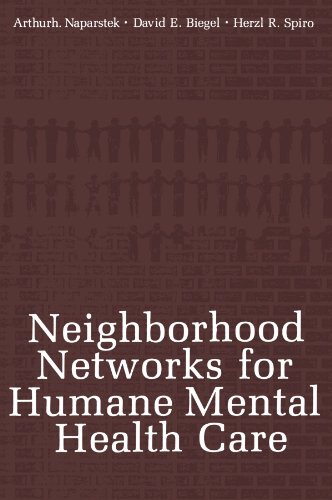
(It is hard to think of a more timely and topical major co...)
It is hard to think of a more timely and topical major contribution than Drs. Naparstek, Biegel, Spiro, and collaborators have provided in this volume. Their penetrating, comprehensive study and field tests give us mapping toward the goal of reifying the concept of "community" as applied to human services. The book will prove invaluable to those at the policy level-legislators, planners, and administrators. It will serve as an essential reference for community workers-professional provid ers, natural helpers, and citizens as a whole. A salient ideal of New Federalism-placing governance as close to the people as practicable-seems a prophetic match with the model of Neighborhood Empowerment. As the authors point out, conventional wisdom has seemed to offer government regulation, control, and pro gram evaluation as a panacea package for improving human services. This work suggests a radically different approach; specifically, a shift to greater instrumental involvement of the richly variegated mosaic of American neighborhoods, combined with a system of excellent, high technology service agencies. Certainly, genuine efforts have been made before toward a true linkage of the community with human services. The Great Society pro grams, with their emphasis on citizen involvement and "maximum fea sible participation" established the foundation for legitimate citizen/ consumer linkage with the program process. Yet, in so many instances, the results fell far short of expectations.
http://www.amazon.com/gp/product/1468411489/?tag=2022091-20
Biegel, David Eli was born on July 3, 1946 in New York City. Son of Jack and Estelle (Lentin) Biegel.
Bachelor, City College of New York, 1967. Master of Social Work, University Maryland, 1970. Doctor of Philosophy, University Maryland, 1982.
Field coordinator United Farm Workers, American Federation of Labor and Congress of Industrial Organizations, Baltimore, 1971. Executive director Junction, Inc., Westminster, 1971—1972. Director office planning and program development Catholic Charities, Baltimore, 1973—1976.
Center associate, director neighborhood and family services project University Southern California, Washington Public Affairs Center, 1976—1980. Assistant professor social work University Pittsburgh, 1980—1985, associate professor, 1985—1986. Henry L. Zucker professor social work practice Mandel School Applied Social Sciences, Case Western Reserve University, since 1987, professor psychiatry and sociology, since 1987, associate dean research & training, since 2008, co-director Center for Practice Innovations, 1991—1997, chair doctoral program, 1998—2001, 2005.
Co-director Cuyahoga County Community Mental Health Research Institute, 1994—2002. President Institute for the Advancement of Social Work Research, 1999—2002. Director research and evaluation Ohio Substance Abuse and Mental Illness Coordinator Center Excellence, 2000—2005.
Co-director Center Substance Abuse and Mental Illness, since 2002.
(This book provides human service practitioners, policy ma...)
( Among the significant trends in human services during t...)
(Building Support Networks for the Elderly is concerned wi...)
(This bibliography contains 1,340 annotated citations cove...)
(It is hard to think of a more timely and topical major co...)
Consultant Volunteer Volunteers in Service to America, Raton, New Mexico, and Baltimore, 1967-1970. Active Big Brothers American, Baltimore, 1974-1977' president board trustees Bridgeway, Inc., 2004-2007. Secretary board trustees Community Care Network, Inc., 2006-2007^.
Fellow Gerontological Society of America. Member National Association of Social Workers, Academy Certified Social Workers, Society Social Work Research.
Married Margaret S. Smoot, January 31, 1976 (divorced). 1 child, Geoffrey S. Married Ronna Kaplan, October 26, 2003.
