

Background
Pizer, Donald was born on April 5, 1929 in New York City. Son of Morris and Helen (Rosenfeld) Pizer.

( American Naturalism and the Jews examines the unabashed...)
American Naturalism and the Jews examines the unabashed anti-Semitism of five notable American naturalist novelists otherwise known for their progressive social values. Hamlin Garland, Frank Norris, and Theodore Dreiser all pushed for social improvements for the poor and oppressed, while Edith Wharton and Willa Cather both advanced the public status of women. But they all also expressed strong prejudices against the Jewish race and faith throughout their fiction, essays, letters, and other writings, producing a contradiction in American literary history that has stymied scholars and, until now, gone largely unexamined. In this breakthrough study, Donald Pizer confronts this disconcerting strain of anti-Semitism pervading American letters and culture, illustrating how easily prejudice can coexist with even the most progressive ideals. Pizer shows how these writers' racist impulses represented more than just personal biases, but resonated with larger social and ideological movements within American culture. Anti-Semitic sentiment motivated such various movements as the western farmers' populist revolt and the East Coast patricians' revulsion against immigration, both of which Pizer discusses here. This antagonism toward Jews and other non-Anglo-Saxon ethnicities intersected not only with these authors' social reform agendas but also with their literary method of representing the overpowering forces of heredity, social or natural environment, and savage instinct.
http://www.amazon.com/gp/product/0252033434/?tag=2022091-20
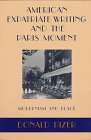
(Montparnasse and its cafe life, the shabby working-class ...)
Montparnasse and its cafe life, the shabby working-class area of the place de la Contrescarpe and the Pantheon, the small restaurants and cafes along the Seine, and the Right Bank world of the well-to-do...for American writers self-exiled to Paris during the 1920s and 1930s, the French capital represented what their homeland could not a milieu that through the freedom of thought and action it permitted and the richness of life it offered, nurtured the full expression of the creative imagination. How these expatriates interpreted and gave modernist shape to the myth of "the Paris moment" in their writing is the altogether fresh focus of Donald Pizer's study of seven of their major works. Through careful readings of the texts, Pizer identifies both the common threads in the expatriates' response to the Paris moment and the distinctive expression each work gives to their shared experience. Most important, he addresses the neglected question of how the portrayal of the Paris scene helps shape a specific work's themes and form. He traces such experimental devices as fragmented or cubistic narrative forms, the dramatic representation of consciousness, and sexual explicitness, and explores the powerful and evocative tropes of mobility and feeding. As Pizer demonstrates, Paris between the two world wars was for the American expatriates more than a geographical entity. It was a state of mind, an experience that engendered the formal expression of a personal aesthetic. The engaging and significant interplay between artist, place and innovative self-reflexive forms composes, Pizer maintains the most distinctive contribution of expatriate writing to the literary movement called high modernism.
http://www.amazon.com/gp/product/0807122203/?tag=2022091-20

( The Novels of Theodore Dreiser was first published in 1...)
The Novels of Theodore Dreiser was first published in 1976. Minnesota Archive Editions uses digital technology to make long-unavailable books once again accessible, and are published unaltered from the original University of Minnesota Press editions. Relying heavily on the manuscripts and letters in the Dreiser Collection of the University of Pennsylvania Library, Professor Pizer seeks to establish the facts of the sources and composition of each of Dreiser's eight novels and to study the themes and form of the completed works. In this study he relates what can be discovered about the factual reality of a novel to its imaginative reality. His interpretation of the novels avoids the suggestion that there is a single overriding theme or direction in Dreiser's work and emphasizes that Dreiser deserves examination primarily on the basis of the individuality and worth of each of his novels. A separate chapter is devoted to each of the novels: Sister Carrie, Jennie Gerhardt, The "Genius," The Financier, The Titan, An American Tragedy, The Bulwark, and The Stoic.
http://www.amazon.com/gp/product/0816607680/?tag=2022091-20
http://www.amazon.com/gp/product/B00Y2RLZQA/?tag=2022091-20

( The 1966 edition of this book has become a standard wo...)
The 1966 edition of this book has become a standard work. In this new, revised edition, Pizer has dropped three chapters and has refined and extended the work by adding six: American Literary Naturalism: An Approach Through Form,” American Literary Naturalism: The Example of Dreiser,” The Problem of Philosophy in the Naturalistic Novel,” Hamlin Garland’s 1891 Main-Travelled Roads: Local Color as Art,” Jack London: The Problem of Form,” and Dreiser’s Nigger Jeff’: The Development of an Aesthetic.” The book contains definitions of realism and naturalism based on representative novels of the period ranging from Howells’ Rise of Silas Lapham to Crane’s Red Badge of Courage; analyses of the literary criticism of the age, stressing that of Howells, Garland, and Norris; and close readings of specific works by major figures of the period.
http://www.amazon.com/gp/product/0809311259/?tag=2022091-20

(The present book, full of valuable insights and fresh per...)
The present book, full of valuable insights and fresh perspectives, is a welcome addition to our knowledge of realism and naturalism in the American literature of the late nineteenth century. The author begins with a chapter on realism followed by one on naturalism and in each of these he extends the subject's possibilities. The author views realism, not in the customary manner; instead of harping on the limitations of realism, he broadens the concept to include, in relation to novels of the late 19th century, a subjective element and an ethical idealism.
http://www.amazon.com/gp/product/080930192X/?tag=2022091-20

( In his first book devoted exclusively to naturalism, Do...)
In his first book devoted exclusively to naturalism, Donald Pizer brings together thirteen essays and four reviews written over a thirty-year period that in their entirety constitute a full-scale interpretation of the basic character and historical shape of naturalism in America. The essays fall into three groups. Some deal with the full range of American naturalism, from the 1590s to the late twentieth century, and some are confined either to the 1890s or to the twentieth century. In addition to the essays, an introduction in which Pizer recounts the development of his interest in American naturalism, reviews of recent studies of naturalism, and a selected bibliography contribute to an understanding of Pizer’s interpretation of the movement. One of the recurrent themes in the essays is that the interpretation of American naturalism has been hindered by the common view that the movement is characterized by a commitment to Emile Zola’s deterministic beliefs and that naturalistic novels are thus inevitably crude and simplistic both in theme and method. Rather than accept this notion, Pizer insists that naturalistic novels be read closely not for their success or failure in rendering obvious deterministic beliefs but rather for what actually does occur within the dynamic play of theme and form within the work. Adopting this method, Pizer finds that naturalistic fiction often reveals a complex and suggestive mix of older humanistic faiths and more recent doubts about human volition, and that it renders this vital thematic ambivalence in increasingly sophisticated forms as the movement matures. In addition, Pizer demonstrates that American naturalism cannot be viewed monolithically as a school with a common body of belief and value. Rather, each generation of American naturalists, as well as major figures within each generation, has responded to threads within the naturalistic impulse in strikingly distinctive ways. And it is indeed this absence of a rigid doctrinal core and the openness of the movement to individual variation that are responsible for the remarkable vitality and longevity of the movement. Because the essays have their origin in efforts to describe the general characteristics of American naturalism rather than in a desire to cover the field fully, some authors and works are discussed several times (though from different angles) and some referred to only briefly or not at all. But the essays as a collection are "complete" in the sense that they comprise an interpretation of American naturalism both in its various phases and as a whole. Those authors whose works receive substantial discussion include Stephen Crane, Frank Norris, Theodore Dreiser, Edith Wharton, James T. Farrell, Norman Mailer, Joyce Carol Oates, and William Kennedy. Of special interest is Pizer’s essay on Ironweed, which appears here for the first time.
http://www.amazon.com/gp/product/0809318474/?tag=2022091-20

( Scorned by critics since birth, decreed dead by many, n...)
Scorned by critics since birth, decreed dead by many, naturalism, according to Donald Pizer, is one of the most persistent and vital strains in American fiction, perhaps the only modern literary form in America that has been both popular and significant.” To define naturalism and explain its tenacious hold throughout the twentieth century on the American creative imagination, Pizer explores six novels: James T. Farrell’s Studs Lonigan, John Dos Passos’s U.S.A., John Steinbeck’s The Grapes of Wrath, Norman Mailer’s The Naked and the Dead, William Styron’s Lie Down in Darkness, and Saul Bellow’s The Adventures of Augie March. Pizer’s approach to these novels is empirical; he does not wrench each novel awkwardly until it fits his framework of generalizations and principles; rather, he approaches the novels as fiction and arrives at his definition through his close reading of the works. Establishing the background of naturalism, Pizer explains that it comes under attack because it is sordid and sensational in subject matter,” it challenges man’s faith in his innate moral sense and thus his responsibility for his actions,” and it is so full of social documentation” that it is often dismissed as little more than a photographic record of a life or an era; thus the aesthetic validity of the naturalistic novel has often been questioned.” Pizer posits the 1890s, the 1930s, and the late 1940s as the decades when naturalism flourished in America. He concentrates on literary criticism, not on the philosophy of naturalism, to show that literary criticism can make a contribution to a particularly muddled area of literary historya naturalism that is alive and changing, thus resisting the neat definitions reserved for the dead.
http://www.amazon.com/gp/product/0809310279/?tag=2022091-20
http://www.amazon.com/gp/product/B000KUOPSI/?tag=2022091-20

http://www.amazon.com/gp/product/B011DBHKN4/?tag=2022091-20

http://www.amazon.com/gp/product/0846217945/?tag=2022091-20

http://www.amazon.com/gp/product/0838316662/?tag=2022091-20
http://www.amazon.com/gp/product/B005KE48UE/?tag=2022091-20
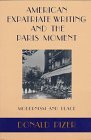
(American Expatriate Writing and the Paris Moment : Modern...)
American Expatriate Writing and the Paris Moment : Modernism and Place by Donald Pizer. Louisiana State University Press,1996
http://www.amazon.com/gp/product/B008VRQPUS/?tag=2022091-20

http://www.amazon.com/gp/product/B00Y2RLXPI/?tag=2022091-20
Pizer, Donald was born on April 5, 1929 in New York City. Son of Morris and Helen (Rosenfeld) Pizer.
Bachelor of Arts, University of California at Los Angeles, 1951; Master of Arts, University of California at Los Angeles, 1952; Doctor of Philosophy, University of California at Los Angeles, 1955.
Member faculty, Tulane University, since 1957; Professor of English, Tulane University, 1964-1972; Pierce Butler Professor of English, Tulane University, since 1972; Mellon professor humanities, Tulane University, 1978-1979.
( In his first book devoted exclusively to naturalism, Do...)
( Scorned by critics since birth, decreed dead by many, n...)
(Montparnasse and its cafe life, the shabby working-class ...)
(The present book, full of valuable insights and fresh per...)
( American Naturalism and the Jews examines the unabashed...)
(American Expatriate Writing and the Paris Moment : Modern...)
( The Novels of Theodore Dreiser was first published in 1...)
( The 1966 edition of this book has become a standard wo...)
Served with Army of the United States, 1955-1957. Member Modern Language Association.
Married Carol Hart, April 7, 1966. Children– Karin, Ann, Margaret.
