

Background
Engelberg, Edward was born on January 21, 1929 in Chemnitz, Germany. Son of Jakob and Paula (Weber) Engelberg.
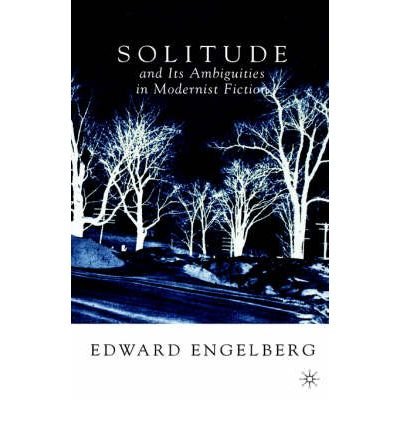
(In this study of solitude in high modernist writing, Edwa...)
In this study of solitude in high modernist writing, Edward Engelberg explores the ways in which solitude functions thematically to shape meaning in literary works, as well as what solitude as a condition has contributed to the making of a trope. Selected novels are analyzed for the ambiguities that solitude injects into their meanings. The freedom of solitude also becomes a burden from which the protagonists seek liberation. Although such ambiguities about solitude exist from the Bible and the Ancients through the centuries following, they change within the context of time. The story of solitude in the 20th century moves from the self's removal from society and retreat into nature to an extra-social position within which the self confronts itself. A chapter is devoted to the synoptic analysis of solitude in the West, with emphasis on the Renaissance to the 20th century, and another chapter analyzes the ambiguities that set the stage for modernism: Defoe's "Robinson Crusoe". Selected works by Woolf, Mann, Camus, Sartre, and Beckett highlight particular modernist issues of solitude and how their authors sought to resolve them.
http://www.amazon.com/gp/product/B00MZDCTMM/?tag=2022091-20
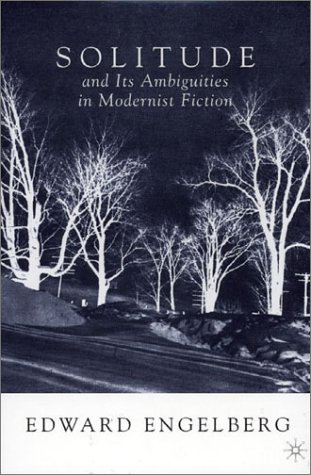
( In this study of solitude in modernist fiction, Edward ...)
In this study of solitude in modernist fiction, Edward Engelberg explores the ways in which solitude functions thematically to shape meaning in literary works, and how solitude as a condition has contributed to the making of a topos. Selected novels are analyzed to highlight the ambiguities that solitude brings to their meanings. The freedom that solitude bestows also becomes a burden from which the protagonists seek release. Although such ambiguities about solitude have existed from the Bible and the Ancients through the centuries following, they alter their shape within the context of time. The story of solitude in the 20th century moves from the Self's removal from society and retreat into nature to a condition external to Society, where the Self confronts itself, with uncertain consequences. A chapter is devoted to a synoptic analysis of solitude in the West, with emphasis on the Renaissance to the 20th century, and another chapter analyzes the ambiguities of solitude that set the stage for modernism: Defoe's Robinson Crusoe ; selected works by Woolf, Mann, Sartre, Camus, and Beckett illuminate particular modernist issues of solitude and how their authors sought to resolve them.
http://www.amazon.com/gp/product/0312239475/?tag=2022091-20
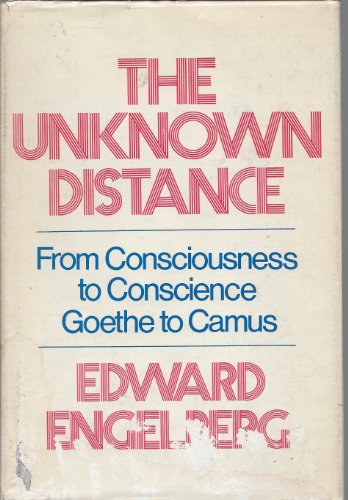
( Edward Engelberg argues that Conscience and Consciousn...)
Edward Engelberg argues that Conscience and Consciousness have slowly drifted apart from their once nearly identical meanings: inward knowledge of oneself. This process of separation, he shows, reached a critical point in the late eighteenth and nineteenth centuries, the age of "dualisms." Tracing the evolution of the severance of Conscience from Consciousness, he demonstrates from a wide range of examples in literature and philosophy how such a division shaped the attitudes of important writers and thinkers. The study opens with the Romantics and closes with Kafka, Hesse, and Camus. It includes analyses of Hegel, Dostoevsky, James, Conrad, and Freud and brings together for comparison such pairings as Poe and Mann, Goethe and Wordsworth, Arnold and Nietzsche. Engelberg concludes that the cleavage of Conscience from Consciousness is untenable. To dispossess Conscience, he asserts, man would also need to dispossess a full awareness, a full Consciousness; and a full Consciousness inevitably leads back to Conscience.
http://www.amazon.com/gp/product/0674929659/?tag=2022091-20
http://www.amazon.com/gp/product/B011DBI9WU/?tag=2022091-20
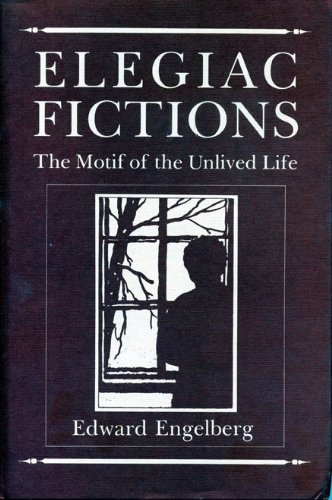
(In dealing with the motif of the 'unlived life,' Edward E...)
In dealing with the motif of the 'unlived life,' Edward Engelberg explores an important and hitherto neglected chapter in the history of modern thought. He analyzes literary works chiefly from the nineteenth and early twentieth centuries novels, short stories, and some plays - within the context of a number of psychological and philosophical concepts to sustain his argument.Engelberg's premise is that in this period we begin to see what he calls the 'elegizing of the self' - that is, mourning over one's shortcomings, failures, disappointments - in short, the 'unlived life,' the perception that the hero or heroine has missed the opportunities of living, that it is now 'too late' to achieve what has become known today as 'self-actualization.' Engelberg also analyzes how the motif was acted out and what 'symptoms' accompanied its expression. To this end he makes use of Freud's essays 'Mourning and Melancholia' and 'On Narcissism,' as well as the idea of 'narcissistic rage' advanced by Heinz Kohut. In addition, he draws upon Schopenhauer's 'pessimism,'' Nietzsche's conception of 'history,' and Max Scheler's theory of ressentiment.This study, then, identifies a special state of mind: the 'elegiac' cries of despair that emanate from a wide variety of fictional personae. There are no simple answers as to why these feelings were expressed so frequently and passionately from the Romantics onward, but one cause is surely the double-edged effect of the emergence of the 'autonomous self.' With 'autonomy' came anxiety, fear, and a feeling of impotence. And these states in turn generated a variety of reactions: self-images of 'superfluousness,' expressions of 'narcissistic rage,' and states of 'mourning and melancholia.' The book will interest a variety of constituencies beyond the literary establishment: psychologists, intellectual historians, philosophers - in short, all who are interested in cultural phenomena and their literary expression.
http://www.amazon.com/gp/product/0271006579/?tag=2022091-20
comparative literature educator
Engelberg, Edward was born on January 21, 1929 in Chemnitz, Germany. Son of Jakob and Paula (Weber) Engelberg.
Bachelor, Brooklyn College, 1951. Master of Arts, University Oregon, 1952. Doctor of Philosophy in English, University Wisconsin, 1957.
Associate Professor of English, University of Michigan, Ann Arbor, 1957-1965; associate professor comparative literature, Brandeis U., Waltham, Massachusetts, 1965-1967; professor comparative literature and European cultural studies, department Romance and comparative literature Brandeis U., Waltham, Massachusetts, since 1967.
(In this study of solitude in high modernist writing, Edwa...)
( In this study of solitude in modernist fiction, Edward ...)
( Edward Engelberg argues that Conscience and Consciousn...)
(In dealing with the motif of the 'unlived life,' Edward E...)
Member Modern Language Association, American Comparative Literature Association (advisory committee 1988-1991), Phi Beta Kappa (Distinguished Alumnus award 1994).
Married Elaine A. Rosen, July 27, 1950. Children: Stephen Paul, Michael Joseph, Elizabeth Joyce.
