

Background
Keenan, Edward L. was born on December 10, 1937 in Somerset, Pennsylvania, United States.
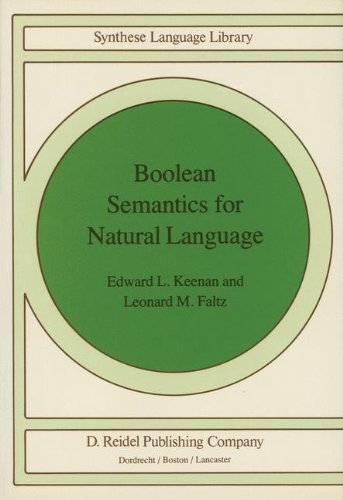
(In the spring of 1978, one of the authors of this book wa...)
In the spring of 1978, one of the authors of this book was sitting in on a course in logic for linguists given by the other author. In attempting to present some of Montague's insights in an elementary way (hopefully avoid ing the notation which many find difficult at first), the authors began dis cussions aimed towards the construction of a simple model-theoretical semantic apparatus which could be applied directly to a small English-like language and used to illustrate the methods of formal logical interpretation. In these discussions two points impressed themselves on us. First, our task could be simplified by using boolean algebras and boolean homomorphisms in the models; and second, the boolean approach we were developing had much more widespread relevance to the logical structure of English than we first thought. During the summer and fall of 1978 we continued work on the system, proving the more fundamental theorems (including what we have come to call the Justification Theorem) and outlining the way in which an intensional interpretation scheme could be developed which made use of the boolean approach (which was originally strictly extensional). We presented our findings in a monograph (Keenan and Faltz, 1978) which the UCLA Linguistics Department kindly published as part of their series called Occa sional Papers in Linguistics; one of the authors also presented the system at a colloquium held at the Winter Meeting of the Linguistic Society of America in December 1978.
http://www.amazon.com/gp/product/9027717680/?tag=2022091-20
http://www.amazon.com/gp/product/B010BDQRDE/?tag=2022091-20
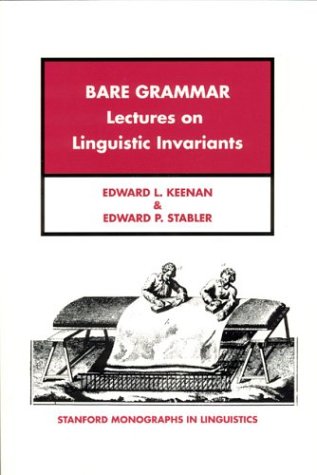
( Drawing on general algebraic notions of structure and s...)
Drawing on general algebraic notions of structure and symmetry, this volume explores the invariants of generative grammars, showing how structural notions in generative grammar are provably invariant in grammars, and specific morphemes are invariant in exactly the same sense in languages that have them. Edward Keenan and Edward Stabler’s analysis illustrates how relations such as the anaphor-antecedent relation can be invariant in all grammars, even if realized differently in different languages, and it argues that the existence of universal invariants does not assume that grammars of different languages are isomorphic. Bare Grammar ultimately concludes that the relation between form and meaning is not entirely arbitrary.
http://www.amazon.com/gp/product/1575861887/?tag=2022091-20
http://www.amazon.com/gp/product/B011YTTKU6/?tag=2022091-20
Keenan, Edward L. was born on December 10, 1937 in Somerset, Pennsylvania, United States.
Bachelor in Philosophy and Religion, Swarthmore College, 1959. Diploma in literature, University Paris, Sorbonne, 1961. Certified in French literature, University Paris, Sorbonne, 1962.
Master of Arts in Linguistics, George Washington University, 1966. Doctor of Philosophy in Linguistics, University Pennsylvania, 1969.
Senior fellow King's College, Cambridge, England, 1970—1974. Visiting professor University Amsterdam, Netherlands, 1977, University Tel Aviv, 1978—1979. Fellow Max Planck Institute for Psycholinguistics, Nijmegen, Netherlands, 1984—1985.
Fulbright scholar University Antananarivo, Madagascar, 1995. Professor linguistics University of California at Los Angeles, since 1974.
( Drawing on general algebraic notions of structure and s...)
(In the spring of 1978, one of the authors of this book wa...)
Member of American Association for the Advancement of Science, American Civil Liberties Union, Linguistic Society of America, American Mathematics Society.
Married Carol Archie. 1 child David.
