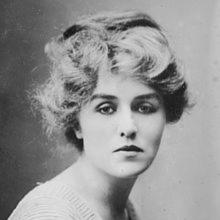
Emily Stevens was a stage and screen actress in Broadway plays in the first three decades of the 20th century and later in silent movies.
Background
Emily was born on February 27, 1882 in New York City, New York, United States, daughter of Robert E. Stevens and Emma (Maddern) Stevens. Her grandfather on her mother's side was Richard Maddern, an English musician who came to America in mid-nineteenth century with a large family, and organized a traveling concert company composed of his own children.
Education
She was educated at the Institute of the Holy Angels, Fort Lee, New Jersey, and at Saint Mary's Hall, Burlington, New Jersey.
Career
When Stevens was twenty played Miriam with her cousin, Minnie Maddern Fiske, in the latter's production of Mary of Magdala. She remained with Mrs. Fiske for some years, playing Lady Blanche in a revival of Becky Sharp, and Berta in Hedda Gabler early in the century. Leaving her cousin's company, she acted with George Arliss in The Devil in 1908, and in Septimus, 1909. But it was not till the season of 1915-16 that she became a "featured" player.
In 1914-15 she made an unsuccessful attempt in a fairy play called The Garden of Paradise, by Edward Brewster Sheldon, with scenery by Joseph Urban which rather over-topped the frail play. When she appeared in New York, October 9, 1915, in The Unchastened Woman, by Louis Kaufman Anspacher, however, she was widely acclaimed. Her role was that of a witty, worldly, rather neurasthenic woman, restless and cruel, yet charming; and she made a minute and effective character study of the part. The play was very successful. An equally good new role was not forthcoming for some time, but she won attention with a revival of Hedda Gabler.
On March 3, 1924, at the Garrick Theatre, New York, she appeared as Mathilde Fay in the Theatre Guild's production of Fata Morgana, by Ernest Vajda, which enjoyed a long and prosperous run. Here again she was a woman of the world - restless, somewhat predatory, bored, subtle - and again she made of the role a fascinating character study. The next season she appeared in The Makroupoulos Secret, based on the legend of the woman who has eternal youth. That was her last prominent role.
She died on January 2, 1928 in New York.
Achievements
Emily Stevens's first true New York success was in Septimus (1909) at the Walleck's Theatre. Her next achievement followed by a performance as leading lady in The Boss for Holbrook Blinn. Stevens' other noteworthy roles included the leading female role in The Child by Elizabeth Apthorp in 1913; To-Day by George Howells Broadhurst; the leading role in The Garden of Paradise by Edward Sheldon.
Works
book
book
Views
Her methods of acting had, quite naturally, been shaped by observation of her cousin when she was in Mrs. Fiske's company, and at times her voice and inflection echoed the older player's startlingly. But there the likeness ceased. Her playing was neither so brilliant nor so brittle as her cousin's; her stage personality was much less intellectual and much more alluringly feminine, though she was unable to suggest emotional depth. Her strength lay in depicting with minute understanding modern women of the world, witty, charming, and sexually restless.
Personality
Strikingly fair in appearance, with a mass of gold hair, with brilliant eyes and coloring, she could assume the role of beautiful and alluring women without difficulty. She was herself witty, with an ironical twist of humor, which further fitted her for the parts in which she excelled.
Connections
She never married. At some point early in her acting career, Stevens developed a girlhood crush on Harrison Fiske, the husband of her cousin Minnie Fiske. She seems to never have pursued a relationship with him but enough coworkers and family knew of her feeling for Fiske as it is presented in a biography on Minnie Fiske by Archie Binns. She seems to have stayed true to her feelings for Harrison Fiske as she did not pursue relationships with other men.