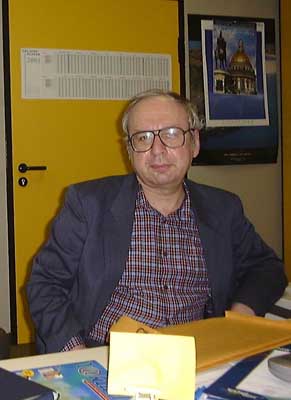
Gregory Yakovlevich Slepyan is a Belarusian physicist and researcher specializing in microwave and millimeter-wave electrodynamics, nonlinear waves, antennas, nanoelectronics, nanophotonics, and quantum nanoantennas. He is also a recognized composer of chess studies and a FIDE Master for Chess Compositions.
Background
Gregory Yakovlevich Slepyan was born on May 6, 1952, in Minsk, Belarus. He is the son of Yakov Aronovich and Myza Grigorievna. During his early professional years he was identified as a radio engineer and began publishing chess studies in 1967, combining a scientific career with sustained activity in chess composition.
Education
Slepyan studied engineering at the Minsk Radioengineering Institute from 1974 to 2000 and completed the program in Engineering. He subsequently pursued advanced scientific research in radiophysics, completing a candidate dissertation in 1978 on nonlinear interaction between electron beams and electromagnetic fields in irregular microwave systems with space-charge effects, and a doctoral dissertation in 1987 on numerical-analytical methods of electrodynamics for problems involving absorption, nonlinearity, and complex boundaries.
Career
Slepyan began his professional career in 1974 at the Minsk Device Design Institute, where he served as a principal research scientist until 1992. From 1992 to 2000 he worked at the Institute for Nuclear Problems, developing research in microwave theory and techniques, antennas and propagation, nonlinear oscillations and waves, and free-electron lasers. His later work at the Research Institute for Nuclear Problems of Belarusian State University expanded toward nanoelectronics, nanophotonics, carbon-nanotube electrodynamics, quantum dots, and quantum antennas. His research has addressed diffraction and scattering, resonators, nonlinear electromagnetic processes, low-dimensional structures, terahertz radiation, and the interaction of quantum emitters with photonic environments. He has collaborated with researchers in Belarus, Israel, Italy, the United Kingdom, and the United States on theoretical and applied nanoelectromagnetics.
Achievements
Conducted research in the physics of nanostructures and their applications in nanoelectronics and nanophotonics.
Developed theoretical studies in microwave theory and techniques, antennas and propagation, nonlinear oscillations and waves, and free-electron lasers.
Contributed to the development of nanoelectromagnetics through research on carbon nanotubes, quantum dots, low-dimensional structures, and quantum antennas.
Published approximately 60 chess studies and received more than 40 distinctions in composition competitions.
Was a finalist in the sixth World Team Championship and a prize-winner of the Belarusian individual championship in chess studies.
(Co-authored review of quantum antennas as open quantum sy...)
2022
Interests
Chess composition and the creation of chess studies.
Sport & Clubs
Chess composition.
Connections
Slepyan is the son of Yakov Aronovich and Myza Grigorievna. His professional and scientific collaborations have included researchers associated with Belarusian State University, the Research Institute for Nuclear Problems, Tel Aviv University, and other international institutions.
Father:
Yakov Aronovich
Mother:
Myza Grigorievna
References
Math-Net.Ru: Gregory Yakovlevich Slepyan
Biographical and bibliographic profile documenting Slepyan's birth date, doctoral degree, radiophysics specialization, research areas, dissertations, publications, and affiliation with the Institute for Nuclear Problems of Belarusian State University.
Modern composers: Slepyan
Profile documenting Slepyan's work as a chess-study composer, his published compositions, competition distinctions, championship participation, and FIDE Master title.
Grants from the International Association for the Promotion of Co-operation with Scientists from the New Independent States of the Former Soviet Union in 1997–2000, 1998–2001, and 2004; and from the North Atlantic Treaty Organization in 1998–2004, 2004–2005, and 2005–.
Grants from the International Association for the Promotion of Co-operation with Scientists from the New Independent States of the Former Soviet Union in 1997–2000, 1998–2001, and 2004; and from the North Atlantic Treaty Organization in 1998–2004, 2004–2005, and 2005–.