(Emma Bovary, a bored provincial housewife, abandons her h...)
Emma Bovary, a bored provincial housewife, abandons her husband to pursue the libertine Rodolphe in a desperate love affair. A succès de scandale in its day, Madame Bovary remains a powerful and scintillating novel.
(Based on Flaubert's own youthful passion for an older wom...)
Based on Flaubert's own youthful passion for an older woman, Sentimental Education was described by its author as "the moral history of the men of my generation." It follows the amorous adventures of Frederic Moreau, a law student who, returning home to Normandy from Paris, notices Mme Arnoux, a slender, dark woman several years older than himself.
(Based on the story of the third-century saint who lived o...)
Based on the story of the third-century saint who lived on an isolated mountaintop in the Egyptian desert, it is a fantastical rendering of one night during which Anthony is besieged by carnal temptations and philosophical doubt.
(First published in 1877, these three stories are dominate...)
First published in 1877, these three stories are dominated by questions of doubt, love, loneliness, and religious experience—together they confirm Flaubert as a master of the short story.
(In this, his last novel, unfinished on his death in 1880,...)
In this, his last novel, unfinished on his death in 1880, Flaubert attempted to encompass his lifelong preoccupation with bourgeois stupidity and his disgust at the banalities of intellectual life in France.
(As a young man looks back on the years that have brought ...)
As a young man looks back on the years that have brought him to "madness," he recalls the innocence of his boyhood and his fond belief that he was blessed with a mind of genius. Yet, painfully, wretchedly, he also recounts his all-too-sudden entry into the adult world. For the day he caught sight of a beautiful woman by the sea marked the end of his flamboyant philosophizing, and the beginning of a tragic coming of age.
(Throughout his life Flaubert made it a game to eavesdrop ...)
Throughout his life Flaubert made it a game to eavesdrop for the cliché, the platitude, the borrowed and unquestioned idea with which the "right thinking" swaddle their minds. After his death his little treasury of absurdities, of half-truths and social lies, was published as a Dictionnaire des idées reçues.
(At once a classic of travel literature and a penetrating ...)
At once a classic of travel literature and a penetrating portrait of a “sensibility on tour,” Flaubert in Egypt wonderfully captures the young writer’s impressions during his 1849 voyages.
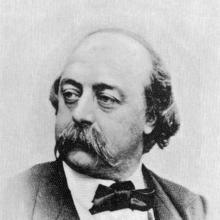
Gustave Flaubert was a French novelist. He was one of the most important forces in creating the modern novel as a conscious art form and in launching, much against his will, the realistic school in France.
Background
Gustave Flaubert was born on December 12, 1821, in Rouen, France; the son of Anne Justine Caroline (née Fleuriot) and Achille-Cleophas Flaubert. Fearing his father, he found outlets for his overflowing affections in his mother and younger sister. His sister died in childbirth when Flaubert was 24, but his mother lived (usually with him) until his fiftieth year. He was tied to her by bonds of love and exasperation, which he never fully understood.
Education
Gustave was educated at the Lycée Pierre Corneille in Rouen, and did not leave until 1840, when he went to Paris to study law and where his desultory efforts were largely unsuccessful. He abandoned his legal studies, since any emotional excitement brought on an attack of temporal-lobe epilepsy.
After several false starts Flaubert turned to writing of The Temptation of Saint Anthony, the story of the desert hermit of Egypt, which was a convenient focus for his concerns with religion and sexuality and for giving scope to his enjoyment of erudite research. He completed the first version in 1849, but unfortunately, it proved unpublishable. This was a bitter blow, and during the next 25 years he intermittently revised the work.
After this failure Flaubert left immediately for a long-planned 20-month journey through the eastern Mediterranean, accompanied by his lifelong friend Maxime Du Camp. He had studied Egypt and the Holy Land for Saint Anthony, and their familiarity upon first sight confirmed his view that art could conjure up reality. He returned via Greece and Italy, the classical lands whose esthetic, with the insistence on simplicity, control, and serenity, formed a further focus in his work.
In 1851 Flaubert embarked upon Madame Bovary, on which he worked until 1856. It was published in 1857 and created a storm; Flaubert, in fact, was unsuccessfully tried on the charge of contributing to public depravity. In addition to satirizing the provincial bourgeoisie, this work tells of Emma Bovary, who as a girl attends a convent school where she acquires romantic notions of a lover who will live for her alone. She marries a good but simple doctor, Charles Bovary, who adores her but does not understand her romantic fantasies, and she then has two love affairs. When, at the end, she finds her dream world in shreds about her, she prefers death to accepting a world not consonant with her fantasies and commits suicide. At a more profound level, the book is the profession of faith of an author who had outgrown romanticism and knew its premises were false. The man of whom Emma dreamed could not exist; the only man who would tell her what she wished sought only an easy seduction. She was foredoomed from the moment she adopted romantic fantasies in the convent.
The publication of Madame Bovary made Flaubert a celebrity. A floundering school of French writers who called themselves realists (markedly inferior to their later American counterparts) imitated Flaubert's use of careful documentation and a rather commonplace subject and proclaimed him their master. In Paris he came to know most of the important people of his day: members of the imperial court, the Goncourt brothers, George Sand, to whom he became devoted, and later the younger men such as Émile Zola, Alphonse Daudet, and Ivan Turgenev. He withdrew, however, each spring to Croisset, a village near Rouen.
Flaubert's next work, Salammbo (1862), recounted the revolt of the mercenaries against Carthage in the 3d century B. C. In it he gave free rein to his penchant for archeological documentation and his delight in the ancient world. Unfortunately, the novel is tedious and repetitious, and few readers have been moved by this mythological account of the fusion of sexuality with religion and their joint culmination in death and annihilation.
Flaubert's scrupulously accurate reconstruction of antiquity, however, did influence later historical novels. In 1864 Flaubert started work on A Sentimental Education, which was published in 1869.
His great Parisian novel is the equal of Madame Bovary although less popular. It presents a satiric panorama of Flaubert's generation. The weak, cowardly hero, Frederic Moreau, experiences early adoration for an older married woman, Marie Arnoux. This situation is drawn from Flaubert's own life, and Marie Arnoux is one of his greatest creations. Frederic tries many careers and penetrates most of the important milieus of France in the mid-century. Each new episode is a new hope for him; each ends in disillusionment, suggests that unfulfilled dreams are always superior to reality, which annihilates them. Henry James, James Joyce, and the "new novel" in France since World War II all owe something to it.
The end of the 1860's and the start of the 1870's were a period of disasters for Flaubert. He was stunned by the deaths of many of his closest friends. The minor poet and dramatist Louis Bouilhet had been his constant counselor and confidant for 20 years, and his death in 1869 was an irreparable loss. Flaubert also mourned the deaths of the critic Charles Augustin Sainte-Beuve (1869) and the writer Théophile Gautier (1872). In 1872 he lost his mother, the culminating blow. Flaubert's despair shows in his next work, a revision (the third) of his earlier Temptation of Saint Anthony (1874).
Flaubert had brought up the orphaned niece of his beloved sister. His niece met financial disaster in 1875, and he sacrificed his fortune in a vain attempt to stave off her ruin. Impoverished, unable to help her further yet despairing over both their plights, he turned with a humility he had never known before to the preparation of his Three Tales (1877). The first two of these are among the best 19th-century French short stories. "A Simple Heart" recounts the selfless devotion of a servant, Felicite, through a lifetime of service. The second, a retelling of the medieval "Legend of Saint Julian the Hospitaller," shows the saint killing his father and mother and making atonement during the rest of his life. Neither tale is ironic; each conveys a symbolic message. The third tale, "Herodias," is less successful but states the message directly through John the Baptist, who gladly accepts his fate: for the Messiah to come, he, the predecessor, must willingly die. Felicite and St. Julian had also learned to put the welfare of others above their own and to seek happiness only in the fullness of love. It was the wisdom Flaubert had learned in his own sacrifices for his niece.
Flaubert began his uncompleted last work, Bouvard and Pecuchet, before the financial crisis of his niece; he continued it after he had finished the Three Tales. He thought of it as inaugurating a new genre, the philosophical novel; it has been the subject of much dispute. Two rather simple copy clerks come into an inheritance, retire to the country, and study one subject after another, each time with renewed excitement and hopefulness and each time ending in disaster. A Sentimental Education had reviewed all of contemporary society and found it hollow; all of religion had been examined in Saint Anthony and had been found wanting; so in Bouvard and Pecuchet, all knowledge is scrutinized and found futile. Much in Bouvard and Pecuchet is great satire; much is hilarious; much becomes deeply sad; but some of it has been deemed tedious. And in the absence of its second half, it is not absolutely clear what Flaubert intended to suggest. It was, however, a seminal work for James Joyce. On May 8, 1880, Flaubert was struck down by a brain hemorrhage after having spent his last years in anguish.
Gustave Flaubert is mostly known for his book Madame Bovary, which is considered to be a masterpiece because of its underlying concerns - sexuality, religion, and annihilation - and Flaubert's analysis, and because of his success in giving them form in his novel. Madame Bovary displayed a new technique for writing ironic novels which writers were to imitate for many generations.
(Emma Bovary, a bored provincial housewife, abandons her h...)
1856
Religion
Flaubert's work Temptation summarizes his lifelong preoccupation with religion and proposes the doctrines of his friend Ernest Renan that all religions are equally true and equally false, equally beautiful and equally a source of anguished nostalgia since they all must perish.
Views
Flaubert believed writers must write of the observed, actual facts; his documentation became legendary. To this extent he partook of the scientism of his period. He wished the writer to be, like the scientist, objective, impartial, impersonal, and impassive. But while the scientist generalizes his truths into a law of nature, Flaubert asked the writer to generalize his observations into an ideal, a type, whose dynamic power becomes apparent through the artistry of its presentation. Finally, Flaubert was a convinced Platonist who accepted the Socratic dictum that the True, the Beautiful, and the Good are one. If the writer presented the True through the Beautiful, his work would also be morally good.
In his Madame Bovary Flaubert represents the view of modern woman, who has been perverted by society to shallow or false ideals and thus cannot follow her own nature to its true fulfillment in real love, which would combine in one transcendent experience the fullest physical experiences with the richest spiritual ones. These concepts embody Flaubert's principal themes: sexuality, religion, and annihilation.
Quotations:
"Do not read, as children do, to amuse yourself, or like the ambitious, for the purpose of instruction. No, read in order to live."
"Be steady and well-ordered in your life so that you can be fierce and original in your work."
"There is not a particle of life which does not bear poetry within it."
"Be regular and orderly in your life, so that you may be violent and original in your work."
"Human speech is like a cracked kettle on which we tap crude rhythms for bears to dance to, while we long to make music that will melt the stars."
"Travel makes one modest. You see what a tiny place you occupy in the world."
"At the bottom of her heart, however, she was waiting for something to happen. Like shipwrecked sailors, she turned despairing eyes upon the solitude of her life, seeking afar off some white sail in the mists of the horizon. She did not know what this chance would be, what wind would bring it her, towards what shore it would drive her, if it would be a shallop or a three-decker, laden with anguish or full of bliss to the portholes. But each morning, as she awoke, she hoped it would come that day; she listened to every sound, sprang up with a start, wondered that it did not come; then at sunset, always more saddened, she longed for the morrow."
"Are the days of winter sunshine just as sad for you, too? When it is misty, in the evenings, and I am out walking by myself, it seems to me that the rain is falling through my heart and causing it to crumble into ruins."
"She wanted to die, but she also wanted to live in Paris."
"One can be the master of what one does, but never of what one feels."
"Never touch your idols: the gilding will stick to your fingers."
"It’s hard to communicate anything exactly and that’s why perfect relationships between people are difficult to find."
"Doubt … is an illness that comes from knowledge and leads to madness."
"I am irritated by my own writing. I am like a violinist whose ear is true, but whose fingers refuse to reproduce precisely the sound he hears within."
"What better occupation, really, than to spend the evening at the fireside with a book, with the wind beating on the windows and the lamp burning bright...Haven't you ever happened to come across in a book some vague notion that you've had, some obscure idea that returns from afar and that seems to express completely your most subtle feelings?"
"The art of writing is the art of discovering what you believe."
Personality
During his student life, Flaubert had easy access to what he called "the bitter poetry of prostitution," and this led to venereal disease, from which he never recovered. His attitudes toward women were colored by these experiences, and the subject of love became an obsessive focal issue in his works. He early linked sexuality to religion, which he felt was a similar longing for certainty always frustrated by doubt. Both areas brought him notions of doom, death, and annihilation.
In 1845 Flaubert had his first attack of temporal-lobe epilepsy. He was helplessly crippled by his seizures, which became hideous terror for him and recurred at intervals throughout his life.
Physical Characteristics:
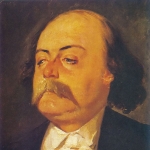
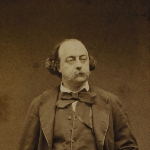
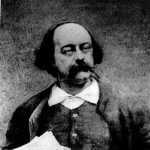
Flaubert was a blond giant of a man with green eyes and a resonant actor's voice.
Quotes from others about the person
James Wood: "Novelists should thank Flaubert the way poets thank spring; it all begins again with him. There really is a time before Flaubert and a time after him. Flaubert decisively established what most readers and writers think of as modern realist narration, and his influence is almost too familiar to be visible. We hardly remark of good prose that it favors the telling and brilliant detail; that it privileges a high degree of visual noticing; that it maintains an unsentimental composure and knows how to withdraw, like a good valet, from superfluous commentary; that it judges good and bad neutrally; that it seeks out the truth, even at the cost of repelling us; and that the author's fingerprints on all this are paradoxically, traceable but not visible. You can find some of this in Defoe or Austen or Balzac, but not all of it until Flaubert."
Vladimir Nabokov: "The greatest literary influence upon Kafka was Flaubert's. Flaubert who loathed pretty-pretty prose would have applauded Kafka's attitude towards his tool. Kafka liked to draw his terms from the language of law and science, giving them a kind of ironic precision, with no intrusion of the author's private sentiments; this was exactly Flaubert's method through which he achieved a singular poetic effect. The legacy of his work habits can best be described, therefore, as paving the way towards a slower and more introspective manner of writing."
Connections
Flaubert never married and never had children. As an adolescent of 15, Flaubert fell platonically in love with an older married woman, Elisa Schlésinger, and remembered her ever after as a pure and unsullied love. A few years later he toyed briefly with the idea of marriage but never again seriously considered it. He then did have love affairs, but they were never central to his life; most important were his stormy affairs with the poet Louise Colet in 1846-1847 and again in 1851-1854 and his affectionate relationship with Juliet Herbert, the governess of his niece, which began in the mid-1850's and lasted to the end of his life.
Father:
Achille-Cleophas Flaubert
Achille-Cleophas Flaubert was a Medical Doctor and practiced surgery in Rouen.
Mother:
Anne Justine Caroline
Anne Justine Caroline (née Fleuriot; 1793–1872) was from an aristocratic Norman family.
Flaubert's Parrot
A kind of detective story, relating a cranky amateur scholar's search for the truth about Gustave Flaubert, and the obsession of this detective whose life seems to oddly mirror those of Flaubert's characters.
Flaubert: A Life
Wall's is the first full-fledged modern biography of this immeasurably talented and influential artist. Flaubert brilliantly re-creates the life and times of a writer who wrote to within an inch of his life and whose importance will never diminish.