

Background
Drache, Hiram Max was born on August 18, 1924 in Waseca, Minnesota, United States. Son of Paul Albert and Anna Louise (Schultz) Drache.

(Hardback 239p, Index,)
Hardback 239p, Index,
http://www.amazon.com/gp/product/B000PDJLI4/?tag=2022091-20
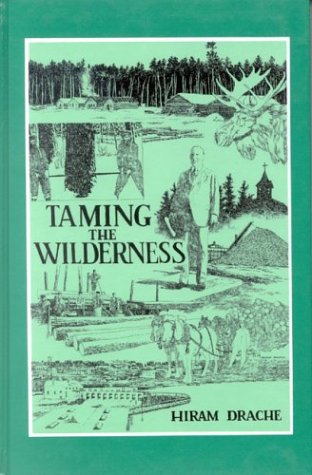
(An account of one of the most isolated frontiers in the l...)
An account of one of the most isolated frontiers in the lower 48 states where many people came to exploit the public domain and then left. Legitimate homesteaders came, settled, and to a large extent failed, while thousands of lumberjacks – living in lumber camps – toiled to harvest nature’s bounty.
http://www.amazon.com/gp/product/0813429277/?tag=2022091-20

(The prairies are one of the greatest gifts to humankind f...)
The prairies are one of the greatest gifts to humankind for on those fertile and wide-open lands pioneers built a civilization and a culture, which has fed millions. This book presents the challenges to first settlers along the Red River of Northern Minnesota. Homesteaders settled the unbroken lands of the frontier and faced almost endless obstacles to conquer the soil. Women bore the brunt of the burden, but children and men were not exempt from the agony of the daily drudgery. The homestead was free, but the price paid in toil, sweat, tears, and broken bodies were great. Failure was more common than success.
http://www.amazon.com/gp/product/0813419948/?tag=2022091-20

http://www.amazon.com/gp/product/B0019LE4CO/?tag=2022091-20

(Book by Drache, Hiram M.)
Book by Drache, Hiram M.
http://www.amazon.com/gp/product/0813419956/?tag=2022091-20

(Discover one of the last frontiers in the contiguous 48 s...)
Discover one of the last frontiers in the contiguous 48 states, which were heralded as a great agricultural Garden of Eden. A divergent ethnic composition, long and severe winters, a short growing season, and muskeg swamps intensified the problems of this isolated frontier. But the natural forest and abundance of waterpower helped shape the area’s history. The author focuses on pioneers who settled within a 60 – 70 miles on the northern border of Minnesota in an area extending from Baudette on the west to Kettle Falls on the east. Realizing that this would be some of the last free land, the pioneers had hopes that were probably greater than on earlier frontiers.
http://www.amazon.com/gp/product/0813422876/?tag=2022091-20

(The family farm has long been held up as the strength of ...)
The family farm has long been held up as the strength of rural America and the Nation. Much has been written about the virtuous, but sometimes mythical, family enterprise. This book deals with the changes that have taken place on the land that make the family farm of today different from its 1900 predecessor. Technology in agriculture has changed from horses to four-wheel-drive tractors. Today’s farmer relies on capital, management, and technology to be successful.
http://www.amazon.com/gp/product/0813418585/?tag=2022091-20

http://www.amazon.com/gp/product/B006ZIIZI0/?tag=2022091-20

http://www.amazon.com/gp/product/B01182KF6M/?tag=2022091-20

http://www.amazon.com/gp/product/B001OQGFUS/?tag=2022091-20

(Book by Drache, Hiram M.)
Book by Drache, Hiram M.
http://www.amazon.com/gp/product/0813430763/?tag=2022091-20

(This book offers lively review of one of the most overloo...)
This book offers lively review of one of the most overlooked and yet critical factors in farm management. Farming, probably more than any other industry, has chronically suffered from poor or indifferent management. This is an account of how business-like, management-oriented farmers have succeeded through the erratic economic cycles and may provide insight into the future of American agriculture.
http://www.amazon.com/gp/product/0813424607/?tag=2022091-20

(The Challenge of the Prairie tells the story of the prair...)
The Challenge of the Prairie tells the story of the prairie and how is one of the great gifts to humankind. Because of the fertile and wide-open lands pioneers were able to build a civilization and a culture, which has fed millions to this day. This book presents the challenges faced by the first settlers along the Red River of Northern Minnesota. Here homesteaders settled the unbroken lands of the frontier and experienced seemingly endless obstacles in their quest to conquer the soil. Women bore the brunt of the burden, but children and men were not exempt from the agony of daily drudgery. Though the homestead was free, failure was more common than success and the price paid in toil, sweat, tears, and broken bodies was great.
http://www.amazon.com/gp/product/0913163457/?tag=2022091-20
Drache, Hiram Max was born on August 18, 1924 in Waseca, Minnesota, United States. Son of Paul Albert and Anna Louise (Schultz) Drache.
Bachelor, Gustavus Adolphus College, 1947. Master of Arts, University Minnesota, 1951. Doctor of Philosophy, University North Dakota, 1963.
Instructor, Owatonna (Minnesota) High School, 1948-1950; instructor, Concordia College, Moorhead, Minnesota, 1952-1953; professor of history, Concordia College, Moorhead, since 1955; statistician, Federated Mutual Insurance Company, Owatonna, 1955-1991; historian-in-residence, Concordia College, since 1991.
(The prairies are one of the greatest gifts to humankind f...)
(An account of one of the most isolated frontiers in the l...)
(Discover one of the last frontiers in the contiguous 48 s...)
(The Challenge of the Prairie tells the story of the prair...)
(This book offers lively review of one of the most overloo...)
(The family farm has long been held up as the strength of ...)
(Book by Drache, Hiram M.)
(Book by Drache, Hiram M.)
(Hardback 239p, Index,)
Regent Oak Grove Lutheran High School, Fargo, North Dakota, 1965-1975. Council member Minnesota History Society, St. Paul, since 1968. Member Minnesota Humanities Commission, St. Paul, 1972-1978, Governor's Council on Employment and Training, St. Paul, 1979-1981.
Captain United States Air Force, 1943-1945. Member Agricultural History Society, Minnesota History Society, Great Plains Historical Society, Pi Gamma Museum.
Married Ada Marie Nelson, February 28, 1948. Children: Kay Ellen, David Bryan, Paul Arthur.
