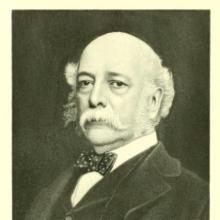
Background
James Duncan Hague was born on February 24, 1836, in Boston, Massachusetts, United States, brother of Arnold Hague and son of Reverend William and Mary Bowditch (Moriarty) Hague.

(Unlike some other reproductions of classic texts (1) We h...)
Unlike some other reproductions of classic texts (1) We have not used OCR(Optical Character Recognition), as this leads to bad quality books with introduced typos. (2) In books where there are images such as portraits, maps, sketches etc We have endeavoured to keep the quality of these images, so they represent accurately the original artefact. Although occasionally there may be certain imperfections with these old texts, we feel they deserve to be made available for future generations to enjoy.
https://www.amazon.com/Mining-Industries-James-Duncan-Hague/dp/1290532060?SubscriptionId=AKIAJRRWTH346WSPOAFQ&tag=prabook-20&linkCode=sp1&camp=2025&creative=165953&creativeASIN=1290532060
James Duncan Hague was born on February 24, 1836, in Boston, Massachusetts, United States, brother of Arnold Hague and son of Reverend William and Mary Bowditch (Moriarty) Hague.
James Hague was given his preliminary education in private schools and in 1854 entered the Lawrence Scientific School of Harvard University. In 1855-1856 he studied at the University of Gottingen, Hanover, and in 1856-1858 at the Royal School of Mines at Freiberg, Saxony.
From 1859 to 1861 James Duncan Hague was a chemist with a South Sea exploring expedition, studying the phosphate deposits of Jarvis, Baker, and adjacent islands. On the outbreak of the Civil War, he entered the United States Navy, serving for a year as judge advocate to the fleet stationed at Port Royal, South Carolina. In 1863 he became superintendent of the Albany & Boston Copper Mine in the Lake Superior region and was also connected with the early developments of the Calumet and Hecla properties.
In 1867 Hague followed his brother Arnold in joining the Geological Survey of the Fortieth Parallel under Clarence King. In this connection, he continued for three years and to the Report of the survey, he contributed the classic third volume, Mining Industry (1870).
From 1871 to 1878 Hague was in private employ as a consulting mining engineer, residing in California; after and until his death his headquarters were in New York. For a number of years, he was president of the company controlling the famous North Star Mine of Grass Valley, California. He died at Stockbridge, Massachusetts, in his seventy-third year.
(Unlike some other reproductions of classic texts (1) We h...)
Hague was a fellow of the American Association for the Advancement of Science, the American Academy of Arts and Sciences, the American Geographical Society, the New York Historical Society, the New England and St. Andrew’s societies, and numerous other organizations.
James Hague was a man of dignified, gentlemanly, and kindly appearance.
In April 1872 James Hague married Mary Ward Foote of Guilford, Connecticut, who died in 1898, leaving him one son and two daughters.