

Background
Chase, Karen Susan was born on October 16, 1952 in St. Louis. Daughter of Stanley Martin and Judith Chase.
http://www.amazon.com/gp/product/B00Y2UVJL8/?tag=2022091-20
http://www.amazon.com/gp/product/0416365205/?tag=2022091-20

(Middlemarch is the prime example of George Eliot's dictum...)
Middlemarch is the prime example of George Eliot's dictum that "interpretations are illimitable," and in this collection of new essays Middlemarch is re-examined as an open text responsive to gaps and fissures, and as resistant to authority as it is to other fixed notions of identity, idealism, and gender. What does the novel omit, and how do the omissions shape what is there? How shall we understand the materiality of the text? What problems does it pose to adaptation? The novel's plasticity becomes a basis for investigation into the multiple forms of expressiveness, and a consideration of how we might plot the patterns linguistically, ideologically, even cinematically. New spaces emerge within character, place, and narrative; what seemed absent or inaccessible assumes shape and definition; Middlemarch remains "Victorian" but it is a Victorianism understood through the dual perspectives of the 19th and 21st centuries. Scholars of George Eliot and students of Victorianism will be engaged by the wide-ranging scope of these essays, which nonetheless build on each other to form a coherent narrative of critical reflections. If there is something for everyone in Middlemarch, there is also something compelling about each of the essays in this collection.
http://www.amazon.com/gp/product/B009CPMQG0/?tag=2022091-20
( Love of home life, the intimate moments a family peacef...)
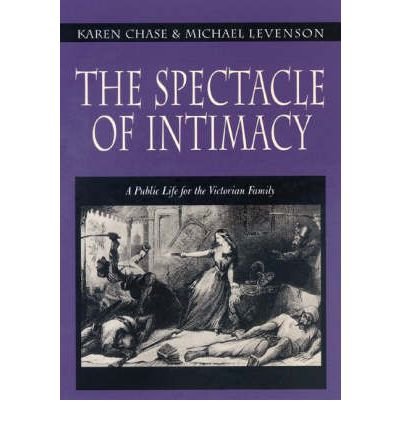
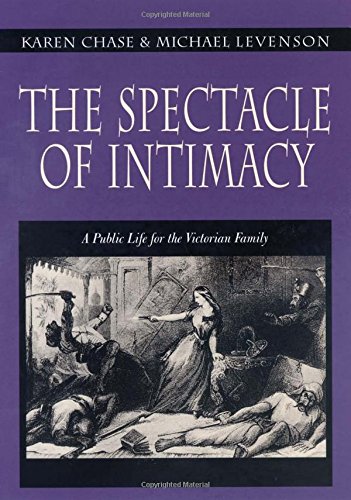
Love of home life, the intimate moments a family peacefully enjoyed in seclusion, had long been considered a hallmark of English character even before the Victorian era. But the Victorians attached unprecedented importance to domesticity, romanticizing the family in every medium from novels to government reports, to the point where actual families felt anxious and the public developed a fierce appetite for scandal. Here Karen Chase and Michael Levenson explore how intimacy became a spectacle and how this paradox energized Victorian culture between 1835 and 1865. They tell a story of a society continually perfecting the forms of private pleasure and yet forever finding its secrets exposed to view. The friction between the two conditions sparks insightful discussions of authority and sentiment, empire and middle-class politics. The book recovers neglected episodes of this mid-century drama: the adultery trial of Caroline Norton and the Prime Minister, Lord Melbourne; the Bedchamber Crisis of the young Queen Victoria; the Bloomer craze of the 1850s; and Robert Kerr's influential treatise, celebrating the ideal of the English Gentleman's House. The literary representation of household life--in Dickens, Tennyson, Ellis, and Oliphant, among others--is placed in relation to such public spectacles as the Deceased Wife's Sister Bill of 1848, the controversy over divorce in the years 1854-1857, and the triumphant return of Florence Nightingale from the Crimea. These colorful incidents create a telling new portrait of Victorian family life, one that demands a fundamental rethinking of the relation between public and private spheres.
http://www.amazon.com/gp/product/0691006687/?tag=2022091-20
Chase, Karen Susan was born on October 16, 1952 in St. Louis. Daughter of Stanley Martin and Judith Chase.
Bachelor, University of California at Los Angeles, 1974. Master of Arts, Stanford University, 1977. Doctor of Philosophy, Stanford University, 1980.
Assistant professor, University of Virginia, Charlottesville, 1979-1985; associate professor, University of Virginia, Charlottesville, 1985-1991; professor, University of Virginia, Charlottesville, since 1992.
(Middlemarch is the prime example of George Eliot's dictum...)
( Love of home life, the intimate moments a family peacef...)
Married Michael H. Levenson, December 30, 1984. Children: Alexander Nathan, Sarah Sophie.
