

Background
Turner, Raymond Marriner was born on February 25, 1927 in Salt Lake City. Son of Marriner Cardon and Margaret (Barber) Turner.
http://www.amazon.com/gp/product/B01N8Y1JJ6/?tag=2022091-20

http://www.amazon.com/gp/product/B0010ZKYLO/?tag=2022091-20

(The Sonoran Desert, a fragile ecosystem, is under ever-in...)
The Sonoran Desert, a fragile ecosystem, is under ever-increasing pressure from a burgeoning human population. This ecological atlas of the region's plants, a greatly enlarged and full revised version of the original 1972 atlas, will be an invaluable resource for plant ecologists, botanists, geographers, and other scientists, and for all with a serious interest in living with and protecting a unique natural southwestern heritage. An encyclopedia as well as an atlas, this monumental work describes the taxonomy, geographic distribution, and ecology of 339 plants, most of them common and characteristic trees, shrubs, or succulants. Also included is valuable information on natural history and ethnobotanical, commercial, and horticultural uses of these plants. The entry for each species includes a range map, an elevational profile, and a narrative account. The authors also include an extensive bibliography, referring the reader to the latest research and numerous references of historical importance, with a glossary to aid the general reader. Sonoran Desert Plants is a monumental work, unlikely to be superseded in the next generation. As the region continues to attract more people, there will be an increasingly urgent need for basic knowledge of plant species as a guide for creative and sustainable habitation of the area. This book will stand as a landmark resource for many years to come.
http://www.amazon.com/gp/product/0816515328/?tag=2022091-20
( The Changing Mile, originally published in 1965, was a ...)
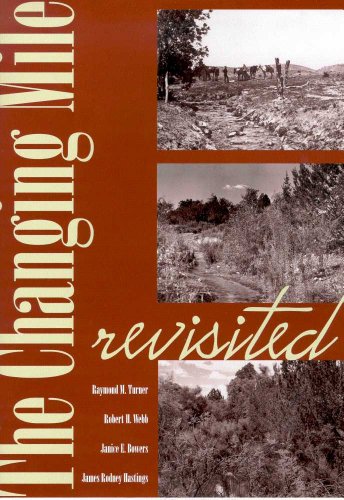
The Changing Mile, originally published in 1965, was a benchmark in ecological studies, demonstrating the prevalence of change in a seemingly changeless place. Photographs made throughout the Sonoran Desert region in the late 1800s and early 1900s were juxtaposed with photographs of the same locations taken many decades later. The nearly one hundred pairs of images revealed that climate has played a strong role in initiating many changes in the region. This new book updates the classic by adding recent photographs to the original pairs, providing another three decades of data and showing even more clearly the extent of change across the landscape. During these same three decades, abundant information about climatic variability, land use, and plant ecology has accumulated, making it possible to determine causes of change with more confidence. Using nearly two hundred additional triplicate sets of unpublished photographs, The Changing Mile Revisited utilizes repeat photographs selected from almost three hundred stations located in southern Arizona, in the Pinacate region of Mexico, and along the coast of the Gulf of California. Coarse photogrammetric analysis of this enlarged photographic set shows the varied response of the region's major plant species to the forces of change. The images show vegetation across the entire region at sites ranging in elevation from sea level to a mile above sea level. Some sites are truly arid, while others are located above the desert in grassland and woodland. Common names are used for most plants and animals (with Latin equivalents in endnotes) to make the book more accessible to non-technical readers. The original Changing Mile was based upon a unique set of data that allowed the authors to evaluate the extent and magnitude of vegetation change in a large geographic region. By extending the original landmark study, The Changing Mile Revisited will remain an indispensable reference for all concerned with the fragile desert environment.
http://www.amazon.com/gp/product/0816523061/?tag=2022091-20
( The Sonoran Desert, a fragile ecosystem, is under ever-...)
The Sonoran Desert, a fragile ecosystem, is under ever-increasing pressure from a burgeoning human population. This ecological atlas of the region's plants, a greatly enlarged and full revised version of the original 1972 atlas, will be an invaluable resource for plant ecologists, botanists, geographers, and other scientists, and for all with a serious interest in living with and protecting a unique natural southwestern heritage. An encyclopedia as well as an atlas, this monumental work describes the taxonomy, geographic distribution, and ecology of 339 plants, most of them common and characteristic trees, shrubs, or succulants. Also included is valuable information on natural history and ethnobotanical, commercial, and horticultural uses of these plants. The entry for each species includes a range map, an elevational profile, and a narrative account. The authors also include an extensive bibliography, referring the reader to the latest research and numerous references of historical importance, with a glossary to aid the general reader. Sonoran Desert Plants is a monumental work, unlikely to be superseded in the next generation. As the region continues to attract more people, there will be an increasingly urgent need for basic knowledge of plant species as a guide for creative and sustainable habitation of the area. This book will stand as a landmark resource for many years to come.
http://www.amazon.com/gp/product/0816525196/?tag=2022091-20
( Dramatically presents the changes man, climate, cattle,...)
Dramatically presents the changes man, climate, cattle, fire, and other factors have wrought upon the natural landscape within a vertical mile over a large region—the northern Sonoran Desert and the highlands within it and to the east.
http://www.amazon.com/gp/product/0816535256/?tag=2022091-20
( Dramatically presents the changes man, climate, cattle,...)
Dramatically presents the changes man, climate, cattle, fire, and other factors have wrought upon the natural landscape within a vertical mile over a large region—the northern Sonoran Desert and the highlands within it and to the east.
http://www.amazon.com/gp/product/0816500142/?tag=2022091-20
Turner, Raymond Marriner was born on February 25, 1927 in Salt Lake City. Son of Marriner Cardon and Margaret (Barber) Turner.
Bachelor of Science, U. Utah, 1948; Doctor of Philosophy, Washington State University, 1954.
Instructor department agronomy and range management, U. Arizona, Tucson, 1954-1956; assistant professor botany, U. Arizona, Tucson, 1956-1962; botanist, United States Geological Survey, Tucson, 1962-1988; retired, 1988. Consultant in field.
( Dramatically presents the changes man, climate, cattle,...)
( Dramatically presents the changes man, climate, cattle,...)
( The Changing Mile, originally published in 1965, was a ...)
(The Sonoran Desert, a fragile ecosystem, is under ever-in...)
( The Sonoran Desert, a fragile ecosystem, is under ever-...)
Married Jeanne Brunner, December 27, 1949. Children: Teresa Linda, Justin Marriner, Martin Albert.
