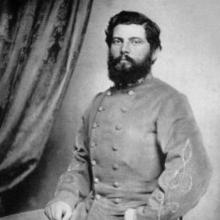
On July 1, 1856, Thomas entered West Point, becoming a member of the five-year class that was graduated in May 1861 without him for, at the outbreak of the Civil War, he resigned.
On July 1, 1856, Thomas entered West Point, becoming a member of the five-year class that was graduated in May 1861 without him for, at the outbreak of the Civil War, he resigned.
Thomas Lafayette Rosser was a major general during the American Civil War. He was also a railroad construction engineer and brigadier general of volunteers in the United States Army during the Spanish-American War.
Background
Thomas Lafayette Rosser was born on October 15, 1836, on his father's farm in Campbell County, Virginia, United States. He was the eldest son of John and Martha Melvina Johnson Rosser. When the boy was thirteen, John Rosser, experiencing reverses, emigrated to the sparsely settled Sabine River country in Texas. Here Thomas worked with his father and a few slaves in developing the frontier plantation.
Education
By rigid economies his parents sent Thomas, at sixteen, to a school at Mount Enterprise, Texas. On July 1, 1856, he entered West Point, becoming a member of the five-year class that was graduated in May 1861 without him for, at the outbreak of the Civil War, he resigned.
Hastening South, Thomas L. Rosser was assigned to the Washington Artillery as the first lieutenant, serving creditably at first Manassas. Promoted captain, he was severely wounded in May 1862 on the Peninsula. On his return to duty, General Stuart obtained his commission as colonel of cavalry, giving him the 5th Virginia Regiment, which he commanded brilliantly for fifteen months.
Leading the van when Pope's headquarters were captured at Catlett's Station, distinguishing himself at second Manassas, South Mountain, and in many cavalry engagements, he abundantly demonstrated the abilities which caused Stuart to pronounce him "a fine artillerist as well as bold Cavalier."
In September 1863 Rosser was promoted brigadier-general. Assuming command of the noted Laurel Brigade at Buckland Mills in October, he roundly defeated Custer, who thenceforth became his perennial rival. In October 1864 he went to the Shenandoah Valley to command Early's cavalry. Largely outnumbered, he suffered defeat by Custer at Woodstock. But though beaten again at Cedar Creek, he kept his troops keen by independent operations, and was promoted major-general on November 1, 1864.
In December he raided New Creek, West Virginia, taking 700 prisoners, 3, 000 horses and cattle, and destroying the railroad shops at Piedmont. The following month, with 300 picked men, he crossed the snow-covered mountains and surprised and captured two entire regiments at Beverly, W. Va. After Pickett's defeat at Five Forks on April 1, 1865, Rosser's division held the Southside Railroad open during the following night, and behaved with desperate valor throughout the subsequent retreat, twice successfully attacking pursuing Union cavalry and taking many prisoners. At Appomattox Rosser charged through the Union lines with two cavalry divisions and escaped to Lynchburg, thus avoiding surrender with Lee's army. He was captured, however on May 2, near Hanover Court-House.
Hard-pressed after the war to support his family, in 1871 Rosser found employment with the Lake Superior & Mississippi Railroad and in 1872 with the Northern Pacific. By ability and energy he soon became chief engineer of the latter, superintending construction to Livingston, Montana. In the Indian country his friendship was renewed with Custer, whose troops often guarded Rosser's surveyors.
After a period as chief engineer of the Canadian Pacific (1881-1886), Rosser, having acquired a competence, in 1886 purchased a fine property, "Rugby," near Charlottesville and became a gentleman farmer.
Commissioned brigadier-general, United States Army, by President McKinley in 1898, he commanded a brigade of Northern volunteers at Chickamauga throughout the Spanish-American war. In 1905 he was appointed postmaster at Charlottesville, and was filling this office when he died.
Achievements
Thomas Lafayette Rosser was a gifted cavalry leader of the audacious American school. Many of his operations deserve attentive study, while his courage and resolution throughout a stormy life compel enduring admiration. Rosser was distinguished by military campaigns at second Manassas, South Mountain, and Gettysburg and in many cavalry engagements. He contributed decisively to the Confederate victory at Trevilian on June 11, 1864. He was noted for his daring cavalry raids, efficiency in handling combat troops, and tactical brilliance.
Connections
On May 28, 1863, Rosser married Elizabeth Barbara Winston, of Hanover Court-House. The couple had six children.