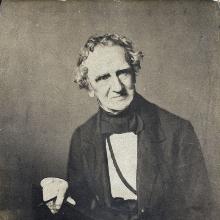
Background
Sully was born in Horncastle, Lincolnshire, England in 1783, to the actors Matthew Sully and Sarah Chester. In March 1792, the Sullys and their nine children emigrated to Charleston, South Carolina, where Thomas’s uncle managed a theater.

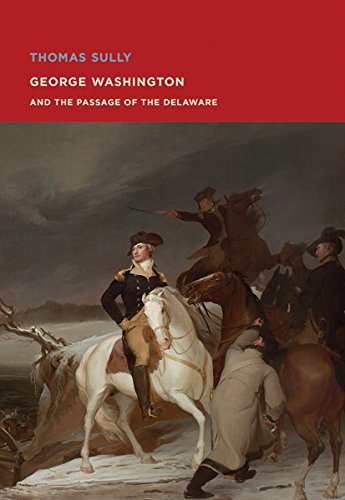
(On the night of December 25, 1776, George Washington led ...)
On the night of December 25, 1776, George Washington led his ragged Continental Army through a snowstorm across the Delaware River, on the way to a surprise attack in New Jersey that would turn the tide of the American Revolution. More than 40 years later, the ambitious young painter Thomas Sully chose this dramatic moment as the subject of a portrait of the founding father commissioned for the North Carolina State House. He combined careful research into contemporary visual and written sources, compositional models drawn from heroic portrayals of the kings and emperors of Europe and American history paintings, and his own flair for theatricality to create a monumental panorama in a new mode that he called a historical portrait. In it, a dramatically lighted Washington urges on the troops from the back of a magnificent white steed, surrounded by fellow generals and aides, while his troops contend with the wintry river crossing below, as dawn breaks on the horizon. "The Passage of the Delaware," the first large-scale painting of this iconic moment, was created in the early years of the burgeoning cult of George Washington, when artists, writers and politicians evoked the heroic deeds of the founding fathers, and particularly their wartime exploits, to foster a sense of national purpose and unity. This compact introduction to the painting reveals how Sullys imagination, technique and ambition came together to embody the drama of the Revolution and the character of its leaders in a manner that inspired viewers of its time and is still stirring today.
http://www.amazon.com/gp/product/0878468331/?tag=2022091-20
Sully was born in Horncastle, Lincolnshire, England in 1783, to the actors Matthew Sully and Sarah Chester. In March 1792, the Sullys and their nine children emigrated to Charleston, South Carolina, where Thomas’s uncle managed a theater.
Sully made his first appearance in the arts as a tumbler at the age of 11 in Charleston. He studied with his brother-in-law Jean Belzons (active 1794–1812), a French miniaturist, until they had a falling-out in 1799. He returned to Richmond to learn "miniature and device painting" from his elder brother Lawrence Sully.
After 1810 he made Philadelphia his home, although in 1838 he visited London to paint a full-length portrait of the young Queen Victoria for the Society of the Sons of St. George of Philadelphia. His masterpiece in portraiture is “Col. Thomas Handasyd Perkins” (1831–32; Boston Athenaeum); his best known painting is “The Passage of the Delaware” (1819; Museum of Fine Arts, Boston).
Sully was an industrious painter who worked rapidly; he left about 2, 000 portraits, a number of miniatures, and more than 500 subject and historical pictures. His paintings are elegant and romantically warm, emphasizing an economy of form and of colour, but his later work suffered from the sentimentality of the mid-19th century. He died in Philadelphia, November 5, 1872.
He painted in the style of Thomas Lawrence, and his subjects included Thomas Jefferson, John Quincy Adams, and Marquis de Lafayette, as well as many leading musicians and composers. He also painted landscapes and historical pieces such as Passage of the Delaware, and his work was used on United States coinage.
(On the night of December 25, 1776, George Washington led ...)
Thomas Sully married his brother's widow, Sarah Annis Sully. He took on the rearing of Lawrence's children and fathered an additional nine children with Sarah. Among the children were Alfred Sully, Mary Chester Sully, Jane Cooper Sully Darley, Blanche Sully, Rosalie Sully, and Thomas Wilcocks Sully.