

Background
Warren Upham was born at Amherst, New Hampshire, the son of Jacob and Sarah (Hayward) Upham, and a descendant of John Upham who emigrated from England to Weymouth, Massachussets, in 1635.

(Greenland Summer of 1894. 448 pages.)
Greenland Summer of 1894. 448 pages.
https://www.amazon.com/GREENLAND-ICEFIELDS-LIFE-NORTH-ATLANTIC-ebook/dp/B0187T2NU0?SubscriptionId=AKIAJRRWTH346WSPOAFQ&tag=prabook-20&linkCode=sp1&camp=2025&creative=165953&creativeASIN=B0187T2NU0

(Excerpt from Minnesota Geographic Names, Vol. 17: Their O...)
Excerpt from Minnesota Geographic Names, Vol. 17: Their Origin and Historic Significance During sixteen years, from 1879 to 1894, of service for the geological surveys of Minnesota, the United States, and Canada, in travel over large areas of this state, the Dakotas, and Manitoba, my attention was often attracted to the origins of their names of places, partly received directly from the Indian languages, and in many other instances translated from the aboriginal names. Frequently our geographic names note remarkable topographic features, or are derived from the fauna and flora. Perhaps a greater number commemorate pioneer white explorers, early fur traders, and agricultural settlers. Later work for the Minnesota Historical Society, since 1895, has permitted and even required more detailed consideration and record in this field. Many memorials of our territorial and state history arc preserved in geographic names, and each nationality contributing to the settlement has its share in this nomenclature. As the first immigrants of the state along the Atlantic and Gulf coast brought many place names from England, France, Holland, and Spain, so in Minnesota many geographic names have come from beyond the sea. Here the influence of a large proportion of immigration from Germany is shown by such names as New Ulm, New Trier, Hamburg, Cologne, and New Munich. Old Bohemia is brought to mind by the city of New Prague. Sweden, Norway, and Denmark are well represented by Stockholm, Malmo, Bergen, Trondhjem, Denmark, and many other township and village names. In the early eastern and southern states, Plymouth, Boston, Portsmouth, Bangor, New York, Charleston, St. Augustine, and New Orleans, recalled tender memories of the Old World. Likewise, these German and Bohemian and Scandinavian names have a great meaning to the immigrants from those countries who have made their new homes here. To illustrate how this subject is like a garden of flowers, or like an epi…
https://www.amazon.com/Minnesota-Geographic-Names-Vol-Significance/dp/1330389433?SubscriptionId=AKIAJRRWTH346WSPOAFQ&tag=prabook-20&linkCode=sp1&camp=2025&creative=165953&creativeASIN=1330389433

(This volume of Minnesota in Three Centuries covers the pe...)
This volume of Minnesota in Three Centuries covers the period of history from the time of the occupation by the Federal Government of Fort Snelling to the admission of the State into the Union. The compiler, Eeturn I. Holcombe, has devoted three years to its compilation and has made extensive research of all works, manuscripts, and papers pertaining to the period of history treated, and the volume contains a large quantity of matter never before published. The compilers manuscript has been carefully revised and approved by General Lucius F. Hubbard, General James H. Baker and Honorable William P. Murray for the Board of Editors. (Typographical errors above are due to OCR software and don't occur in the book.) About the Publisher Forgotten Books is a publisher of historical writings, such as: Philosophy, Classics, Science, Religion, History, Folklore and Mythology. Forgotten Books' Classic Reprint Series utilizes the latest technology to regenerate facsimiles of historically important writings. Careful attention has been made to accurately preserve the original format of each page whilst digitally enhancing the aged text. Read books online for free at www.forgottenbooks.org
https://www.amazon.com/Minnesota-Centuries-1655-1908-Classic-Reprint/dp/1440045925?SubscriptionId=AKIAJRRWTH346WSPOAFQ&tag=prabook-20&linkCode=sp1&camp=2025&creative=165953&creativeASIN=1440045925

(At the beginning of this History of Minnesota, a descript...)
At the beginning of this History of Minnesota, a description of the State is presented in four chapters, treating of its geographic and geologic features, its climate, and the flora and faun 0... Another chapter treats of the Indinns who occupied this region before the first coming of white men, and who afterward continued as it!> principal inhabitants during nearly two hundred years, until the period of white agricultural settlements. The explorat.ions of the area of Minnesota, wbich are the main theme of this first Yolume, were begun in 1655 and 1660 by the two western expeditions of Groseilliers and Radisson. Through more than a century the French pioneers of the fur trade a.nd of missions were the makers and writers of our history. After the cession of New France in 1763 to Great Britain find Spain, the history was continued by English-speaking explorers nod fur traders, United· States government expeditions, :!1ld the national and state geologi About the Publisher Forgotten Books is a publisher of historical writings, such as: Philosophy, Classics, Science, Religion, History, Folklore and Mythology. Forgotten Books' Classic Reprint Series utilizes the latest technology to regenerate facsimiles of historically important writings. Careful attention has been made to accurately preserve the original format of each page whilst digitally enhancing the difficult to read text. Read books online for free at www.forgottenbooks.org
https://www.amazon.com/Minnesota-Centuries-1655-1908-Classic-Reprint/dp/1440068518?SubscriptionId=AKIAJRRWTH346WSPOAFQ&tag=prabook-20&linkCode=sp1&camp=2025&creative=165953&creativeASIN=1440068518

(This volume of Minnesota in Three Centuries, covers the p...)
This volume of Minnesota in Three Centuries, covers the period of the States history from its admission as the thirtysecond member of the Federal Union, until after the close of the Civil War. Minnesota spart in the War of Rebellion has been told by General Lucius F. Hubbard, who took an active part in many of the engagements, that brought forth the preservation of a free and united country. Return I. Holcombe amongst other chapters has contributed the story of the Sioux Outbreak, which devasted the frontiers of the State and in which murder and rapine reigned supreme. These two events constitute an interesting epoch of the States (Typographical errors above are due to OCR software and don't occur in the book.) About the Publisher Forgotten Books is a publisher of historical writings, such as: Philosophy, Classics, Science, Religion, History, Folklore and Mythology. Forgotten Books' Classic Reprint Series utilizes the latest technology to regenerate facsimiles of historically important writings. Careful attention has been made to accurately preserve the original format of each page whilst digitally enhancing the aged text. Read books online for free at www.forgottenbooks.org
https://www.amazon.com/Minnesota-Centuries-1655-1908-Classic-Reprint/dp/1440068526?SubscriptionId=AKIAJRRWTH346WSPOAFQ&tag=prabook-20&linkCode=sp1&camp=2025&creative=165953&creativeASIN=1440068526

(This is a reproduction of a book published before 1923. T...)
This is a reproduction of a book published before 1923. This book may have occasional imperfections such as missing or blurred pages, poor pictures, errant marks, etc. that were either part of the original artifact, or were introduced by the scanning process. We believe this work is culturally important, and despite the imperfections, have elected to bring it back into print as part of our continuing commitment to the preservation of printed works worldwide. We appreciate your understanding of the imperfections in the preservation process, and hope you enjoy this valuable book.
https://www.amazon.com/Lake-Agassiz-chapter-glacial-geology/dp/1172644721?SubscriptionId=AKIAJRRWTH346WSPOAFQ&tag=prabook-20&linkCode=sp1&camp=2025&creative=165953&creativeASIN=1172644721

(This book was originally published prior to 1923, and rep...)
This book was originally published prior to 1923, and represents a reproduction of an important historical work, maintaining the same format as the original work. While some publishers have opted to apply OCR (optical character recognition) technology to the process, we believe this leads to sub-optimal results (frequent typographical errors, strange characters and confusing formatting) and does not adequately preserve the historical character of the original artifact. We believe this work is culturally important in its original archival form. While we strive to adequately clean and digitally enhance the original work, there are occasionally instances where imperfections such as blurred or missing pages, poor pictures or errant marks may have been introduced due to either the quality of the original work or the scanning process itself. Despite these occasional imperfections, we have brought it back into print as part of our ongoing global book preservation commitment, providing customers with access to the best possible historical reprints. We appreciate your understanding of these occasional imperfections, and sincerely hope you enjoy seeing the book in a format as close as possible to that intended by the original publisher.
https://www.amazon.com/Catalogue-Phaenogamous-Cryptogamous-Indigenous-Naturalized/dp/B009AGBPJ0?SubscriptionId=AKIAJRRWTH346WSPOAFQ&tag=prabook-20&linkCode=sp1&camp=2025&creative=165953&creativeASIN=B009AGBPJ0

(History of mining and quarrying in Minnesota. 30 Pages.)
History of mining and quarrying in Minnesota. 30 Pages.
https://www.amazon.com/History-mining-quarrying-Minnesota-Warren-ebook/dp/B014U36ZA6?SubscriptionId=AKIAJRRWTH346WSPOAFQ&tag=prabook-20&linkCode=sp1&camp=2025&creative=165953&creativeASIN=B014U36ZA6
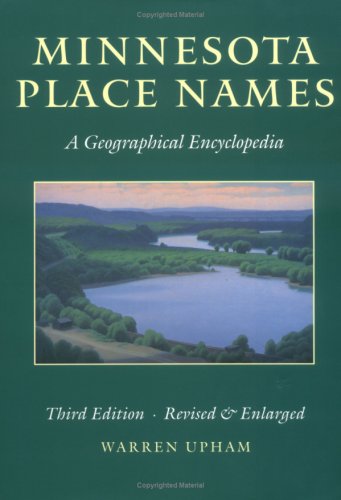
(The names of places, the names that people give to the la...)
The names of places, the names that people give to the land, the rivers, the towns, and the cities, contain miniature history lessons, stories wrapped up in a few words. Naming a place is a way of connecting to it and making it more familar. An important aspect of identity, place names honor the past, telling who came before us, and they speak to the future, telling of our hopes and ambitions. And sometimes, they're simply products of our whimsy. From Big Bird Lake to Cucumber Island, Big Stone to Wanamingo, Puposky Township to the Zumbro River, thousands of discoveries await the reader of Minnesota Place Names: A Geographical Encyclopedia. Newly revised, expanded, and updated, this classic book tells the stories behind more than 20,000 names of the towns and cities, townships and counties, lakes and rivers of the North Star state. This comprehensive volume is a browser's delight and a rich reference for historians, linguists, geographers, folklorists, genealogists, and those interested in the origin of place names. It includes tales for such curious place names as Embarrass and Sleepy Eye, Bemidji and Climax, the Rum River and Man Trap Lake. Did you know that the Rat Root River was named for the roots that fed muskrats that populated its banks, or that Winona is the Dakota word for "first-born daughter"? Published originally in 1920 as the culmination of Warren Upham's lifetime of collecting Minnesota minutiae, this book is a remarkable achievement and classic of Minnesota history. For this revised edition, the staff of the Minnesota Historical Society combed recent literature and databases to update entries and add new names. In this handsome new edition, Minnesota Place Names captures much of the lost lore of familiar places and of towns that have disappeared—and of the people who made the state what it is today.
https://www.amazon.com/Minnesota-Place-Names-Geographical-Encyclopedia/dp/0873513967?SubscriptionId=AKIAJRRWTH346WSPOAFQ&tag=prabook-20&linkCode=sp1&camp=2025&creative=165953&creativeASIN=0873513967

(This work has been selected by scholars as being cultural...)
This work has been selected by scholars as being culturally important, and is part of the knowledge base of civilization as we know it. This work was reproduced from the original artifact, and remains as true to the original work as possible. Therefore, you will see the original copyright references, library stamps (as most of these works have been housed in our most important libraries around the world), and other notations in the work. This work is in the public domain in the United States of America, and possibly other nations. Within the United States, you may freely copy and distribute this work, as no entity (individual or corporate) has a copyright on the body of the work. As a reproduction of a historical artifact, this work may contain missing or blurred pages, poor pictures, errant marks, etc. Scholars believe, and we concur, that this work is important enough to be preserved, reproduced, and made generally available to the public. We appreciate your support of the preservation process, and thank you for being an important part of keeping this knowledge alive and relevant.
https://www.amazon.com/North-America-Bearings-Upon-Antiquity/dp/1344755852?SubscriptionId=AKIAJRRWTH346WSPOAFQ&tag=prabook-20&linkCode=sp1&camp=2025&creative=165953&creativeASIN=1344755852
Warren Upham was born at Amherst, New Hampshire, the son of Jacob and Sarah (Hayward) Upham, and a descendant of John Upham who emigrated from England to Weymouth, Massachussets, in 1635.
He graduated from Dartmouth College in 1871.
After his graduation, Upham was engaged on the geological survey of New Hampshire (1874 - 78), and on the geological survey of Minnesota and the United States Geological Survey (1879 - 95). He went to Minnesota in 1879.
From 1895 to 1914 he was secretary and librarian of the Minnesota Historical Society, and from 1914 to 1933 archeologist of the society. Upham's life affords the unusual example of a diligent scholar at the height of his career in one science changing his major field after the age of fifty. Before 1905 most of his work was in geology; after 1905, in archeology and history.
In 1896 Upham published his paper "The Glacial Lake Agassiz, " United States Geological Survey Monographs, vol. XXV, which included many of the principal results of his studies in Minnesota, North Dakota, and Manitoba. This monograph, a classic on the subject of post-glacial physiography, describes an ancient lake vastly greater than the present Lake Superior, its beaches, deltas, and other shore features that became wonderfully well exposed when the lake shrank to become the present Lake Winnipeg.
In 1896 Upham issued, jointly with G. F. Wright, a volume entitled Greenland Ice Fields and Life in the North Atlantic. His most important historical publications appeared in the Collections of the Minnesota Historical Society, among them "Groseilliers and Radisson, the First White Men in Minnesota" (vol. X, pt. 2, 1905), "Minnesota Biographies" (vol. XIV, 1912), which he compiled with Rose B. Dunlap, and "Minnesota Geographic Names" (vol. XVII, 1920). He was one of the editors of Minnesota in Three Centuries (1908).
He was particularly interested in the history of man before the period of the graphic arts, and published two noteworthy contributions on the subject: "Man in the Ice Age at Lansing, Kan. , and Little Falls, Minn. " (American Geologist, Sept. 1902), and "Valley Loess and the Fossil Man of Lansing, Kan. " (Ibid. , Jan. 1903). Although the conclusions of these discourses were not generally accepted as indisputable proof of the presence of man in North America during the Ice Age, Upham died with the conviction that man inhabited the region beyond the ice edge during at least a part of that period, and discoveries in Minnesota lend strong support to that theory. He died at St. Paul, Minnesota, where he had lived for many years.
An indefatigable and patient worker, Upham published almost two hundred papers on geology. Of these all but about twenty are on glacial geology and nearly related subjects, which were his principal fields of work. His greatest contribution to geology was contained in the fine series of county reports issued by the Minnesota Geological Survey, but his best known paper was "The Glacial Lake Agassiz".
(This volume of Minnesota in Three Centuries covers the pe...)
(At the beginning of this History of Minnesota, a descript...)
(This volume of Minnesota in Three Centuries, covers the p...)
(The names of places, the names that people give to the la...)
(This book was originally published prior to 1923, and rep...)
(This work has been selected by scholars as being cultural...)
(This is a reproduction of a book published before 1923. T...)
(Excerpt from Minnesota Geographic Names, Vol. 17: Their O...)
(History of mining and quarrying in Minnesota. 30 Pages.)
(Greenland Summer of 1894. 448 pages.)
Upham was courtly, modest, unobtrusive, almost retiring until his own field was mentioned; he then became alert, authoritative, and entertaining. He was endeared to all his associates by his modesty regarding his own attainments, his thoughtfulness for others, and his willingness to give without stint both his time and his knowledge.
On October 22, 1885, Upham married Addie M. Bixby of Aurora, Minnesota. There was one child, who died at birth.
