

Background
Preiser, Wolfgang Friedrich Ernst was born on June 26, 1941 in Freiburg, Germany. Son of Gerhard Friedrich and Ursula Helene (von Huelsen) Preiser. came to the United States, 1967.

( The Latest Advances in Universal Design Thoroughly upda...)
The Latest Advances in Universal Design Thoroughly updated and packed with examples of global standards and design solutions, Universal Design Handbook, Second Edition, covers the full scope of universal design, discussing how to develop media, products, buildings, and infrastructure for the widest range of human needs, preferences, and functioning. This pioneering work brings together a rich variety of expertise from around the world to discuss the extraordinary growth and changes in the universal design movement. The book provides an overview of universal design premises and perspectives, and performance-based design criteria and guidelines. Public and private spaces, products, and technologies are covered, and current and emerging research and teaching are explored. This unique resource includes analyses of historical and contemporary universal design issues from seven different countries, as well as a look at future trends. Students, advocates, policy makers, and design practitioners will get a theoretical grounding in and practical reference on the physical and social roles of design from this definitive volume. UNIVERSAL DESIGN HANDBOOK, SECOND EDITION, COVERS: • United Nations Convention on the Rights of Persons with Disabilities • U.S. accessibility codes and standards, including the Americans with Disabilities Act (ADA) • Life safety standards and guidelines • Universal design implementations in Norway, Japan, France, Germany, Brazil, Italy and the Old City of Jerusalem • Planning ADA implementation in public educational institutions • Urban scale and mass transportation universal design • Designing inclusive experiences, including outdoor play settings • Office and workspace design • Universal design in home building and remodeling • Products and technologies, including autos, web access, media, and digital content • Universal design research initiatives, education, and performance assessments
http://www.amazon.com/gp/product/0071629238/?tag=2022091-20

(That the topic ofdesign review is somehow trou My biases...)
That the topic ofdesign review is somehow trou My biases are clearfrom the start: I am among blesome is probably one thing all readers can those who believe that, despite all signals to the contrary, the physical structure of our environ agree on. Beyond this, however, I suspect pros pects of consensus are dim. Differing opinions ment can be managed, and that controlling it is on the subject likely range from those desiring the key to the ameliorationofnumerous problems control tothosedesiringfreedom. Saysonecamp: confronting society today. I believe that design our physical and natural environments are going can solve a host ofproblems, and that the design to hell in a hand basket. Says the other: design of the physical environment does influence be review boards are only as good as their members; havior. more often than not their interventions produce Clearly, this is a perspective that encompasses mediocre architecture. more than one building at a time and demands As a town planner and architect, I am sympa that each building understand its place in a larger thetic to the full range of sentiment. Perhaps a context-the city. Indeed, anyone proposing discussion of these two concepts-control and physical solutions to urban problems is designing freedom-and their differences would now be or, as may seem more often the case, destroying useful. But let me instead suggest that both posi the city.
http://www.amazon.com/gp/product/0412983516/?tag=2022091-20

(That the topic ofdesign review is somehow trou My biases...)
That the topic ofdesign review is somehow trou My biases are clearfrom the start: I am among blesome is probably one thing all readers can those who believe that, despite all signals to the contrary, the physical structure of our environ agree on. Beyond this, however, I suspect pros pects of consensus are dim. Differing opinions ment can be managed, and that controlling it is on the subject likely range from those desiring the key to the ameliorationofnumerous problems control tothosedesiringfreedom. Saysonecamp: confronting society today. I believe that design our physical and natural environments are going can solve a host ofproblems, and that the design to hell in a hand basket. Says the other: design of the physical environment does influence be review boards are only as good as their members; havior. more often than not their interventions produce Clearly, this is a perspective that encompasses mediocre architecture. more than one building at a time and demands As a town planner and architect, I am sympa that each building understand its place in a larger thetic to the full range of sentiment. Perhaps a context-the city. Indeed, anyone proposing discussion of these two concepts-control and physical solutions to urban problems is designing freedom-and their differences would now be or, as may seem more often the case, destroying useful. But let me instead suggest that both posi the city.
http://www.amazon.com/gp/product/0412991616/?tag=2022091-20

( Post-occupancy evaluation, focusing on building’s occup...)
Post-occupancy evaluation, focusing on building’s occupants and their needs, provides insight into the consequences of past design decisions and forms a sound basis for creating better buildings in the future. This book, first published in 1988, includes a review of the evolution of the field, a conceptual frame-work for POE, and pragmatic information on planning, conducting, and reporting POEs. Post-Occupancy Evaluation categorizes the approaches to building evaluation by describing the three levels of POE effort – indicative, investigative, and diagnostic, each differing in terms of time, resources, and personnel needed. In its scope Post-Occupancy Evaluation is both comprehensive and specific; professionals in the design and planning disciplines will find it an invaluable resource for understanding the theory behind POE’s and the procedures needed to put the theory into practice.
http://www.amazon.com/gp/product/0442276052/?tag=2022091-20

http://www.amazon.com/gp/product/B011T7IWNE/?tag=2022091-20
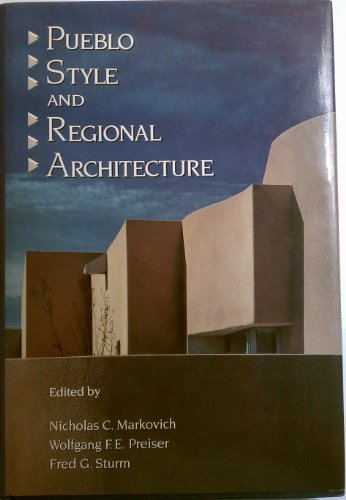
( Few architectural styles evoke so strong a sense of pla...)
Few architectural styles evoke so strong a sense of place as Pueblo architecture. This book brings together experts from architecture and art, archaeology and anthropology, philosophy and history, considering Pueblo style not simply architecturally, but within its cultural, religious, economic, and climate contexts as well. The product of successive layers of Pueblo Indian, Spanish, and Anglo influences, contemporary Pueblo style is above all seen as a harmonious response to the magnificent landscape from which it emerged. Pueblo Style and Regional Architecture, first published in 1990, is a unique and thorough study of this enduring regional style, a sourcebook that will inform and inspire architects and designers, as well as fascinate those interested in the anthropology, culture, art, and history of the American Southwest.
http://www.amazon.com/gp/product/0442318960/?tag=2022091-20

(Design Intervention: Toward a More Humane Architecture, f...)
Design Intervention: Toward a More Humane Architecture, first published in 1991, intends to demonstrate that interest in social issues is alive and well in architecture, that there is a small but effective cadre of dedicated professionals who continue to commit themselves to solving social problems, and that architecture is being applied to the alleviation of the social ills of our time. The editors and contributors in this book have all grappled with their own definitions of design innovation, and express in practical and useful ways their ideas for contributing to a better and less needy world through the architecture they describe. This book will be of interest to students of architecture.
http://www.amazon.com/gp/product/0442273339/?tag=2022091-20

http://www.amazon.com/gp/product/0442009364/?tag=2022091-20
architect educator consultant researcher
Preiser, Wolfgang Friedrich Ernst was born on June 26, 1941 in Freiburg, Germany. Son of Gerhard Friedrich and Ursula Helene (von Huelsen) Preiser. came to the United States, 1967.
Student, Vienna Technology University, 1963. Diploma in Engineering, Architecture, Institute of Technology, 1967. Master in Architecture, Virginia Polytechnic Institute and State University, 1969.
Doctor of Philosophy in Man-Environmental Relations, Pennsylvania State University, 1973.
Architect, Germany, Austria, England, 1960-1966. Professor architecture Virginia Polytechnic Institute and State University, Pennsylvania State University, University Illinois, University New Mexico, University Cincinnati, 1970—2008. Research architect construction engineering research laboratory United States Army, 1973-1976.
Co-director Institute Environmental Education, University New Mexico, 1976-1986. Director Center for Research and Development, University New Mexico, Albuquerque, 1986-1990. Director research Architectural Research Consultant Inc., 1976—2008.
President Planning Research Institute, Albuquerque, 1980—1990. Principal Preiser Consultant, Cincinnati, 1990—2008. Lecturer educational, professional and civic groups worldwide.
Vice president faculty club University New Mexico, 1976-1978. President International Club, Virginia Polytechnic Institute and State University, 1968-1969. Researcher in field.
(Design Intervention: Toward a More Humane Architecture, f...)
( The Latest Advances in Universal Design Thoroughly upda...)
(That the topic ofdesign review is somehow trou My biases...)
(That the topic ofdesign review is somehow trou My biases...)
( Post-occupancy evaluation, focusing on building’s occup...)
( Few architectural styles evoke so strong a sense of pla...)
Trustee Cincinnati Chamber Orchestra, 1992-1998, vice president, 1995-1998. Member of National Academy of Sciences (building research board 1985-1986, chairman committee on programming and post-occupancy evaluation), Environmental Design Research Association (vice chairman 1974-1976, Achievement award 2007, 2010), Society Human Ecology (president 1980-1986), Professor Emeritus of Architecture (life), University Cincinnati Graduate Fellows (secretary 1973-1974), Phi Kappa Phi.
Married Cecilia M. Fenoglio, February 16, 1985. Children: Johanna, Timothy, Andreas, Nicholas.
