

Background
Brooks was born on October 16, 1906, in Murray, Kentucky. His parents were Reverend Cleanth Brooks, and Bessie Lee Witherspoon Brooks (Leitch 2001).


(Publisher Harcourt, Brace & World - 1970 - 3rd Edition - ...)
Publisher Harcourt, Brace & World - 1970 - 3rd Edition - hardcopy - no dust jacket - pages clean - binding tight
http://www.amazon.com/gp/product/0155628070/?tag=2022091-20

( A classic that has been widely used by several generati...)
A classic that has been widely used by several generations, this book consists of detailed commentaries on ten famous English poems from the Elizabethan period to the present. Index.
http://www.amazon.com/gp/product/0156957051/?tag=2022091-20
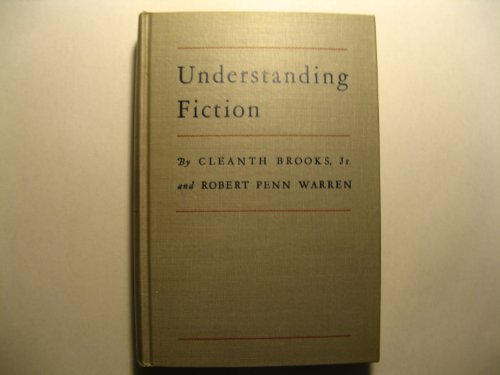
(1943 Hardcover from rockymountaincardsandbooks.com)
1943 Hardcover from rockymountaincardsandbooks.com
http://www.amazon.com/gp/product/B000FLTL18/?tag=2022091-20
http://www.amazon.com/gp/product/B0006D9VSS/?tag=2022091-20

(There is no easy way to learn to write', is the opening l...)
There is no easy way to learn to write', is the opening line of this clear and effective guide for writers wishing to learn the basics of writing whether it is fiction, poetry, news articles or essays. This book including answers to some general problems faced by prospective writers, a section on the kinds of discourse you should wish to achieve and on the exposition. Many of the earliest books, particularly those dating back to the 1900s and before, are now extremely scarce and increasingly expensive. We are republishing these classic works in affordable, high quality, modern editions, using the original text and artwork.
http://www.amazon.com/gp/product/1406707422/?tag=2022091-20
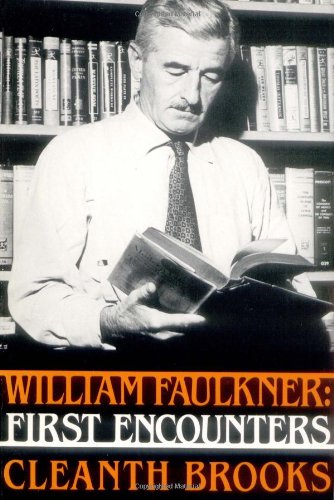
( In this clear-sighted and enjoyable book, Cleanth Brook...)
In this clear-sighted and enjoyable book, Cleanth Brooks, acknowledged to be "the best critic of our best novelist," introduces the general reader to Faulkner's most important novels and stories: The Sound and the Fury; As I lay Dying; The Hamlet; Go Down, Moses; Light in August; and Absalom, Absalom! Brooks focuses on theme, character, and plot as well as on Faulkner's worldthe fictional Yoknapatawpha County that provides a unique setting for Faulkner's tragicomic vision.
http://www.amazon.com/gp/product/0300033990/?tag=2022091-20

( The clarity of style for which Mr. Brooks has long been...)
The clarity of style for which Mr. Brooks has long been noted is displayed to advantage in this newest book of his criticism. Originally delivered as lectures at a faculty conference of people interested in theology, the critical studies have special importance for all readers who would like a fresh perspective on five distinguished literary figures whose Christian commitment has been regarded as nonexistent or nebulous. Mr. Brooks believes that whatever a writer has to say about mankind, Christianity, or culture in general is most significantly explained through his achievements as an artist, and for that reason the critic here deals with the characteristic literary work of each author, rather than with his theology or philosophy.
http://www.amazon.com/gp/product/0300094809/?tag=2022091-20

http://www.amazon.com/gp/product/0151817758/?tag=2022091-20
Brooks was born on October 16, 1906, in Murray, Kentucky. His parents were Reverend Cleanth Brooks, and Bessie Lee Witherspoon Brooks (Leitch 2001).
He studied at Vanderbilt and Tulane universities and was a Rhodes Scholar at Oxford University.
From 1963 to 1972, he was awarded honorary doctorates of literature from Upsala College, the University of Kentucky, the University of Exeter, Washington and Lee University, Saint Louis University, Tulane University, and Centenary College and Oglethorpe University (Singh 1991).
During the 1930's he taught at Louisiana State University, edited The Southern Review with Robert Penn Warren, and collaborated on an influential textbook, Understanding Poetry (1938). The latter, an important example of New Criticism, taught the art of close reading and emphasized a poem's "verbal strategies" as opposed to its "ideas. " In 1939, Brooks' Modern Poetry and the Tradition revaluated English and American poetry by examining the decline of wit. Brooks maintained that the 18th century had spurned metaphysical wit - the wordplay of John Donne and Andrew Marvel - ushering in an age of didactic, unparadoxical poetry. Brooks modified his theory in The Well Wrought Urn (1942), a series of analytic readings based on the assumption that Pope as well as Yeats, Gray as well as Donne - indeed all poets - are concerned with unifying disparate images and figures of speech. In this classic of critical ingenuity, Brooks scrutinizes the paradoxes of individual poems and argues vigorously against the notion of poetry as adornment of feelings and ideas. The Hidden God (1963) turns somewhat from intense analysis toward the exploration of underlying religious and ethical themes in modern literature. Also in this later "contextual" vein, William Faulkner, The Yoknapatawpha Country (1963) shows the breadth of Brooks' scholarship in its discussion of social and cultural problems reflected in Faulkner's major works. Brooks taught at Yale University from 1947 to 1984. As a controversial founding father of the New Criticism, he continued to direct the attention of students and fellow critics to the concrete experience of reading particular works. He died May 10, 1994, in New Haven, Connecticut.
With his writing, Brooks helped to formulate formalist criticism, emphasizing "the interior life of a poem" (Leitch 2001) and codifying the principles of close reading. His best-known works, The Well Wrought Urn: Studies in the Structure of Poetry (1947) and Modern Poetry and the Tradition (1939), argue for the centrality of ambiguity and paradox as a way of understanding poetry.
( In this clear-sighted and enjoyable book, Cleanth Brook...)
(There is no easy way to learn to write', is the opening l...)
( A classic that has been widely used by several generati...)
(Publisher Harcourt, Brace & World - 1970 - 3rd Edition - ...)
(1943 Hardcover from rockymountaincardsandbooks.com)
( The clarity of style for which Mr. Brooks has long been...)
(GREAT VERY RARE FIND)
Brooks held memberships in the American Academy of Arts and Sciences, the National Institute of Arts and Letters, and the American Philosophical Society (Singh 1991).

