

Background
Papert, Seymour Aubrey was born on March 1, 1928 in Pretoria, South Africa. Son of Jack and Betty Papert. came to the United States, 1964.

(At a time when parents wonder how computers are changing ...)
At a time when parents wonder how computers are changing their children's lives, the world's foremost expert on how children learn to work with computers speaks out.
http://www.amazon.com/gp/product/1563523353/?tag=2022091-20

( Mindstorms has two central themes: that children can le...)
Mindstorms has two central themes: that children can learn to use computers in a masterful way and that learning to use computers can change the way they learn everything else. Even outside the classroom, Papert had a vision that the computer could be used just as casually and as personally for a diversity of purposes throughout a person's entire life. Seymour Papert makes the point that in classrooms saturated with technology there is actually more socialization and that the technology often contributes to greater interaction among students and among students and instructors.
http://www.amazon.com/gp/product/0465046746/?tag=2022091-20
http://www.amazon.com/gp/product/B01MU56YD4/?tag=2022091-20

(Will be shipped from US. Brand new copy.)
Will be shipped from US. Brand new copy.
http://www.amazon.com/gp/product/B008VR2VII/?tag=2022091-20
( Perceptrons -- the first systematic study of paralleli...)
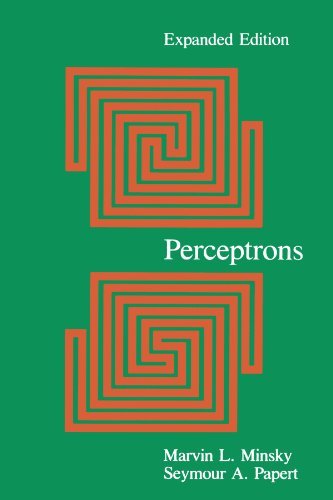
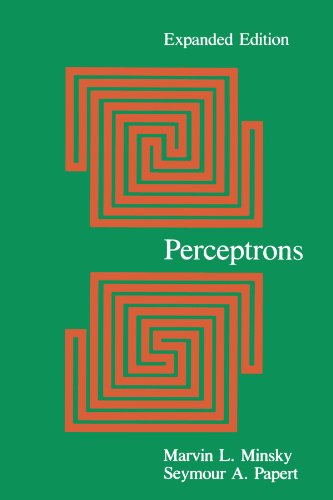
Perceptrons -- the first systematic study of parallelism in computation -- has remained a classical work on threshold automata networks for nearly two decades. It marked a historical turn in artificial intelligence, and it is required reading for anyone who wants to understand the connectionist counterrevolution that is going on today. Artificial-intelligence research, which for a time concentrated on the programming of Von Neumann computers, is swinging back to the idea that intelligence might emerge from the activity of networks of neuronlike entities. Minsky and Papert's book was the first example of a mathematical analysis carried far enough to show the exact limitations of a class of computing machines that could seriously be considered as models of the brain. Now the new developments in mathematical tools, the recent interest of physicists in the theory of disordered matter, the new insights into and psychological models of how the brain works, and the evolution of fast computers that can simulate networks of automata have given Perceptrons new importance. Witnessing the swing of the intellectual pendulum, Minsky and Papert have added a new chapter in which they discuss the current state of parallel computers, review developments since the appearance of the 1972 edition, and identify new research directions related to connectionism. They note a central theoretical challenge facing connectionism: the challenge to reach a deeper understanding of how "objects" or "agents" with individuality can emerge in a network. Progress in this area would link connectionism with what the authors have called "society theories of mind."
http://www.amazon.com/gp/product/0262631113/?tag=2022091-20
Papert, Seymour Aubrey was born on March 1, 1928 in Pretoria, South Africa. Son of Jack and Betty Papert. came to the United States, 1964.
Bachelor of Arts, University Witwatersrand, South Africa, 1949; Doctor of Philosophy, University Witwatersrand, South Africa, 1952; Doctor of Philosophy, Cambridge U., England, 1959.
Co-director artificial intelligence laboratory, Massachusetts Institute of Technology, Cambridge, 1967-1973; director Logo Group, Massachusetts Institute of Technology, Cambridge, 1970-1981; professor mathematics and education, Massachusetts Institute of Technology, Cambridge, since 1964; Cecil and Ida Green professor education, Massachusetts Institute of Technology, Cambridge, 1974-1980; visiting professor mathematics, Rockefeller U., New York City, 1980-1981; science director, Centre Mondial Informatique et Ressource Humaine, Paris, 1982-1983; Lego Professor Learning Research, Massachusetts Institute of Technology, Cambridge, Massachusetts, since 1980.
( In 1969, ten years after the discovery of the perceptro...)
( Mindstorms has two central themes: that children can le...)
(At a time when parents wonder how computers are changing ...)
( Perceptrons -- the first systematic study of paralleli...)
(Will be shipped from US. Brand new copy.)
Married Androula Christofides, April 10, 1963 (divorced);1 daughter, Artemis. Married Sherry Turkle, December 18, 1977 (divorced). Married Suzanne Massie, September 2, 1992.
