Background
Shirley Sterling was born on January 13, 1948, in Merritt, British Columbia, Canada. She is the fourth of seven children of Albert Sterling, a rancher, court interpreter, and war veteran, and Sophie Sterling (maiden name Boght), a homemaker and herbalist.
Education
Shirley Sterling spent her childhood in the Joyaska Indian Reserve in British Columbia’s Nicola Valley growing up in a family of master storytellers, an influence that probably set her on her literary path.
Sterling’s mother, a respected storyteller, was also a reader. With this example before her, Sterling sought refuge in reading when her white skin caused her to be ostracized at the Roman Catholic residential school for First Nations’ children she attended in Kamloops, British Columbia, Canada. She remembers reading Moby Dick in the fifth grade and recalls how strongly she identified with Charles Dickens’s characters, Oliver Twist and David Copperfield. She felt that like her, they were experiencing the loneliness and difficulty of being away from a loving family. Coming from a large loving family, Sterling experienced family life very much.
It was the family that nurtured Sterling’s enthusiasm for learning. Her father valued education highly and encouraged all the children to take it seriously. She attended occasional business courses at the University College of the Cariboo (currently Thompson Rivers University) during the 1980s. Before enrolling at the University of British Columbia, Sterling took courses in subjects as diverse as business and fashion design. She received a Bachelor of Education from the University of British Columbia in 1992. Later, it was followed by a Doctor of Philosophy degree. While at the institution, she also attended a creative writing course.
Career
It was at the University of British Columbia, early in the 1990s, where Shirley Sterling made her first steps to the career of a writer. Asked to write a journal entry about a childhood memory, she told about receiving a parcel from home when she was at residential school. By the end of the course, the journal entry had grown to fifty pages. At the end of a follow-up tutorial, it was book-length, the autobiographical account of a year in the life of a young girl sent to a Native residential school in British Columbia in the late 1950s.
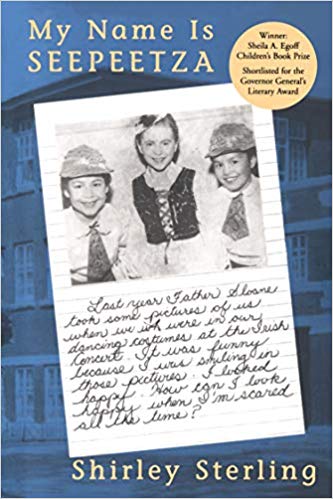
When Sue Ann Alderson, the children’s author who taught the creative writing course, suggested that Sterling send her book to Patsy Aldana, the publisher of Groundwood Books, the author resisted at first. Sterling took the idea home, however, and discussed it with her family, who encouraged her to follow through. Bolstered by their opinion that the book told a story people need to know, Sterling sent the manuscript to Aldana who was, indeed, interested. The path to publication wasn’t entirely smooth, however. Nevertheless, the debut 1992 book entitled ‘My Name is Seepeetza’ has drawn serious literary accolades.
Shirley Sterling has also worked on historical novels based on her father’s and grandmother’s lives gathered in two collections, one of short ‘Seepeetza’ stories and one of poetry. In 1994, the author joined the professors’ staff of her alma mater, the University of British Columbia, as a sessional lecturer.
Views
Quotations:
"Storytelling is part of our lives. When we visit we tell stories."
"I like to take courses, keep busy, keep learning."
"It’s so interesting the extent to which children can understand the way things are. Children are capable of great depth of understanding and feeling."
"Fine arts are so important and aren’t given enough credence in education. If we want balance in children, we need them to engage more in the fine arts. The scientific method objectifies people. The fine arts – storytelling, song, dance, drama – tap into their humanity. What really inspires me is nobility in people. I’m touched when someone does something with great heart and dignity."
Membership
Shirley Sterling has been a member of the Robert William Sterling Memorial Foundation.